Monthly Board report July 2015

This report covers my Waitematā Local Board activities from 1 June – 7 July 2015 as Deputy Chair, lead for the Community and Transport portfolios, Chair of the Grants Committee, and with positions on the Ponsonby Business Association Board, Ponsonby Community Centre Committee and Board liaison for the Parnell Community Centre.

I have also been acting Chair from 19 June – 10 July.

HIGHLIGHTS

Costley Reserve playground opening on 27 June

Costley Reserve playground board members at the opening


 Urban Cycleways programme

Auckland urban cycleways Since December 2014 I have been a member of the Urban Cycleways Investment Panel.  The Panel considered proposed cycleway projects that Councils from across the country put forward for funding from the $100m urban cycling fund, and provided recommendations to the Minister of Transport on the final Urban Cycleway Programme.

On 25 June I attended the launch of the programme by the Prime Minister and Minister of Transport in Rotorua (see Attachment A). On the same day as the launch the governing body signed off the Long -Term Plan budget including the local share of a $124m three year walking and cycling programme which should deliver 52 kilometres of new cycleways.

This is great news especially for the Waitematā Local Board area. After many years of the Board advocating for dedicated cycleways and the completion of the Auckland Cycle Network we will see the acceleration of projects with safe connections on Great North Road, Surry Crescent, Gladstone Road,  a Western Connection via Sarsfield St together with city centre routes.

 Auckland Council’s Long Term Plan

Newmarket laneways open dayThe 10-year budget that was adopted on 25 June by the governing body includes the funded priorities for each local board. The Waitematā Local Board consulted on the following proposals for the next 10 years:

  • complete the Weona-Westmere Coastal Walkway
  • upgrade Newmarket Laneways public realm to provide a safer and more vibrant environment for pedestrians and shoppers
  • deliver the Western Springs Native Bush Restoration Plan
  • redevelop Pioneer Womens and Ellen Melville Hall as a city centre community hub
  • continue the delivery of the Waipapa Stream restoration and ecological project
  • support local community services, events and grants
  • continue to deliver initiatives from our local board plan.

Of the 1,412 submissions received, 745 made comments on the local proposals. Overall the majority of these respondents supported the local proposed projects for 2015/2016 and 2016-2025. In particular, there was support for the implementation of the Waipapa Stream and the Western Springs native bush restoration, the completion of the Weona-Westmere walkway and delivery of local events. There was also strong opposition towards reducing local library opening hours.

After considering the feedback, the board has funded the proposals listed above, and has reduced the budget from $100,000 to $75,000 for a temporary arts and culture POP  programme for which there was lower support. The Board has also allocated funding to support increasing Grey Lynn Library’s opening hours by half an hour a week. (refer Auckland Council media release Attachment B)

Skypath

Resource consent for the walking and cycling pathway over the Auckland Harbour Bridge (Skypath) was granted on 3 July.  This is a significant milestone in a 10 year long campaign to establish this critical link in Auckland’s cycling network.

The Waitematā Local Board has consistently supported the Skypath project. (Photo right from the Get Across protest in 2009 when thousands enjoyed walking and cycling over the bridge)

Grandstand driveGrandstand Drive improved for people to enjoy the Domain

It is surprisingly difficult to move around the Domain without coming into conflict with cars or running out of footpath so it is great to see the parks team have closed the parking on Grandstand drive (due to the risk posed by the oak trees). This is hopefully the start of many further improvements that will progress through the Domain masterplan (to be consulted on in August) and the Museum’s work to improve walking connections.

New footpath programme 15/16

The Transport portfolio provided input to Auckland Transport’s new footpath work programme 15/16.  In Attachment C I explain how I finalised a list of locations with assistance from the public. 

Tactical Urbanism workshop

I attended a workshop with Mike Lydon, Principal Street Plans Collaborative – New York to and author of Tactical Urbanism: Short-term Action for Long-term Change, a book that shares techniques for ambitiously jump starting projects in the urban realm.

tree pit Great North RdThe workshop (hosted by Waterfront Auckland, Auckland Council and Auckland Transport) focused on the opportunities afforded by tactical urbanism, how the ‘lighter, cheaper, faster’ methodology can better deliver desired outcomes for the city, what obstacles lay in the way of achieving the desired outcomes and how we best work together to mitigate these obstacles and achieve the vision for Auckland as the world’s most liveable city. 

The city centre team have a budget of $800k for tactical urbanism projects like pop-up parks. It is great to see that many examples of “tactical urbanism” are already springing up in the community without any support from Council (for example the tree pit in the photo was recently planted after being empty for some time).

New initiative: Vision Zero

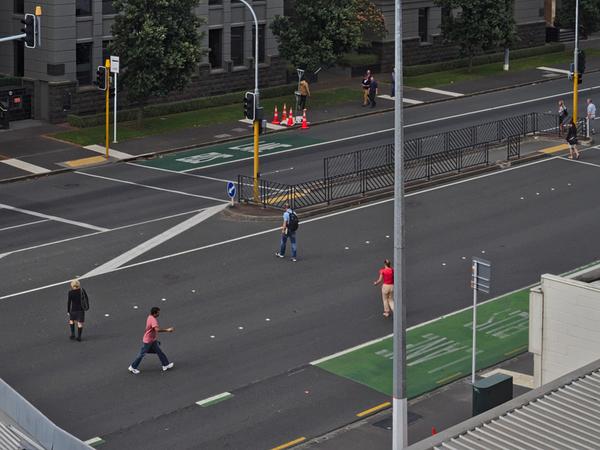
Fanshawe StreetTragically Mr Robert Su was killed on Fanshawe St on 2 June (early indications are that he was crossing at the pedestrian crossing with the green man when he was hit by a speeding truck).    In Attachment D I outline why I think the time has come for Vision Zero Auckland.

Not long after the crash on Fanshawe St Auckland Transport started a misguided and patronising “cross safely with the green man” campaign aimed at the victims of traffic violence. I have raised my concern with Auckland Transport that this kind of approach is shown not to be effective and that resources should be directed at measures that improve pedestrian safety (eg road design, enforcement, speed reduction).

 Workshops and meetings

From 1 June to 7 July I attended:

  • Waitematā Local Board workshop on 2 June
  • Two days of the Skypath resource consent hearing
  • Visit to the Art of remembrance installation at St David’s church to meet Paul Baragwanath, Trustee Friends of St David
  • Communications update with the Local Board communications advisor
  • Engagement adviser update
  • Draft Newmarket Laneways plan open day on Osborne St, Newmarket on Saturday 6 June
  • Waitematā Local Board business meeting on 9 June in Parnell
  • Ponsonby Business Association Board meeting on 10 June
  • Waitematā Local Board workshop on 11 June
  • Draft Newmarket Laneways plan- Stakeholder Workshop at the Rialto Cinema on 11 June
  • Waitematā Local Board workshop on  16 June
  • Community Meeting  on Western Park Development Plan consultation feedback on 16 June
  • Newmarket Laneways Member Working Group Update on 17 June
  • Monthly Transport portfolio catch up on 17  June
  • Meeting to discuss up- coming playground openings
  • Tactical Urbanism workshop with Mike Lydon hosted by Waterfront Auckland  on 22 June
  • Local Board Chairs Forum on 22 June
  • Waitematā Local Board workshop on 23 June
  • Meeting with Ponsonby Business Association reps to discuss parking proposals
  • Franklin Road residents meeting hosted by Auckland Transport to discuss progress on the upgrade of Franklin Road on 23 June
  • Elected member professional development working group meeting
  • Central joint funding committee reestablishment meeting with representatives from Albert-Eden, Orakei, Maungakiekie-Tamaki and Puketapapa Local Boards
  • Senior Advisor/ Relationship manager weekly chairs meeting
  • Ponsonby Community Centre management committee meeting
  • Waitematā Local Board workshop on 30 June
  • Meeting to discuss Auckland Transport’s wayfinding signage proposals
  • Auckland Cycle Forum on 30 June at GridAKL
  • Community Development portfolio monthly update on 1 July
  • Meeting with Matt Ball, Ports of Auckland to discuss proposed Rainbow Warrior memorial art installation
  • Lunchtime learning: Auckland’s Green Lifeline – presentation by Andrea Reid about a new movement that aims to connect Auckland’s parks and reserves together to make pollination pathways.
  • Visited the homelessness Wānaga at Tātai Hono Marae, Grafton hosted by Te Puni Kokiri for Matariki

 Events and functions

Parnell Baths book launchFrom 1 June – 7 July attended:

  • Parnell Baths book launch at the Parnell library on 4 June (photo right)
  • Italian National Day piano concert at the invitation of Dante Alighieri Auckland
  • Parnell Heritage and RSC-Anzac Celebration with member Greg Moyle as guest speaker at the Parnell RSC
  • Kiss the Fish at Q Theatre at the invitation of Indian Ink Theatre Company
  • Waipapa Stream planting day on Saturday 13 June
  • Waipapa planting day July 2015Waitemata Local Board Good Citizen Awards at the Town Hall on 17 June
  • Newmarket Business Association business awards at the Auckland museum at the invitation of the NBA on 19 June
  • Launch of Greater Auckland on 21 June at Golden Dawn
  • Launch of the Urban Cycleways Programme in Rotorua on 25 June
  • Costley Reserve playground opening on 27 June
  • Breakfast celebration at the Zoo to welcome the new elephant Anjalee at the invitation of Regional Facilities Auckland
  • Associates breakfast – urban design, cycling and transport discussion on 2 July at the Auckland Art Gallery
  • Auckland Conversation: Mary Jane Jacob Public Art – what is it good for? on 2 July at St James Theatre
  • Opening of the World Press Photography exhibition at Smith & Caughey on 3 July
  • Skypath resource consent approval celebration at the Northcote Tavern on 3 July
  • Pecha Kucha cycling edition on 7 July at Shed 10 hosted by Auckland Transport

 pecha kucha cycling edition Barbara Grace


Auckland Council Long Term Plan – Waitemata funding decisions

Auckland Council Media Release

29 June 2015

Key Waitematā Local Board projects funded

Completion of the Weona-Westmere Coastal Walkway, continuing the Waipapa Stream restoration and delivering the Western Springs Native Bush Restoration Plan are some of the key Waitematā Local Board projects being funded as a result of public feedback on Auckland Council’s 10-year Budget proposals.

The Waitematā Local Board received 1,412 written submissions. The majority of people who commented on the local proposals supported the board’s initiatives for the coming year 2015-16 and for the Council’s 2016-25 budget.

Other Waitematā Local Board projects being funded include:

  • redeveloping Pioneer Womens and Ellen Melville Hall as a city centre community hub
  • upgrading Newmarket Laneways public realm to provide a safer and more vibrant environment for pedestrians and shoppers
  • supporting local community services, events and grants.

After strong opposition to reducing local library opening hours, the local board has also allocated funding to extend Grey Lynn library’s opening hours by half-an-hour a week.

The board will continue to advocate to council’s governing body and Auckland Transport for investment to improve walking, cycling and road safety.

This includes making a case for a regional budget to allow the implementation of local board Greenway Plans across Auckland.

“We are privileged to have one of Auckland’s most engaged and active communities,” says Waitematā Local Board deputy chair Pippa Coom.

“This is reflected in the quality of the feedback. We’ve listened through the consultation process about the projects the community wants funded.

“The feedback also confirmed that our priorities should continue to focus on a high quality urban design, protecting heritage, advocating for transport improvements and looking after the environment.”

After considering the feedback received, the local board reduced the budget for a temporary arts and culture POP programme – for which there was less support – from $100,000 to $75,000.

The 10-year Budget was adopted by council’s Governing Body at its meeting last Thursday, 25 June.

A full summary of budget decisions, regional and local, can be found at www.aucklandcouncil.govt.nz/longtermplan.


The wheels are spinning for urban cycling

Todd McClay MP for Rotorua,  PM John Key , Richard Leggart (member of the panel)
Todd McClay MP for Rotorua, PM John Key , Richard Leggart (member of the panel)

Urban Cycleways Programme 

When I first became involved in cycle advocacy through Cycle Action in 2008 it was a struggle convincing politicians about the benefits of cycling. It was very common to hear arguments along the lines of “what is the point of spending money on cycling when people don’t and won’t cycle because it is too hilly and rains too much.”

The debate started to slowly move from “why” to “when and how” by the time the super city was established in 2010 and Len Brown was elected on a commitment to cycling.

The “how” got a major boost in August 2014 with the unexpected  announcement of a $100m Urban Cycling Investment Fund by the Prime Minister.  Councils across the country were given a massive incentive to dust off their cycling plans to take advantage of the funding to accelerate urban cycling projects.

Minister Simon Bridges and PM John Key

All credit to the Prime Minister for leading this initiative. It is a smart move that he knows, from his experience of investing in NZ cycle trails, has the potential to yield impressive results.

It was great to be at the launch (as a member of the panel that recommended the programme to the Minister) on 25 June 2015 when the Prime Minister and Minister of Transport jointly announced the full 2015-18 Urban Cycleways Programme  at an event in Rotorua.

It is going to be exciting to see projects progress, cycling networks take shape and more people encouraged to take up cycling in a safe environment.

Media Release

Minister of Transport

25 June 2015

Government delivers $333 million urban cycleways

Transport Minister Simon Bridges has today announced a $333 million cycleways investment that he says will change the face of cycling in New Zealand.

The Minister has announced that, on top of the 13 cycleways projects announced in January, a further 41 will receive funding under the Urban Cycleways Programme.

“This is the single biggest investment in cycling in New Zealand’s history,” he says.

The programme is designed to pull together a range of funding sources to build the best possible cycling network that benefits all New Zealanders.

“The Government’s $100 million Urban Cycleways Fund has helped generate an overall investment of $333 million in cycling, getting world-class projects underway much sooner than may otherwise have been the case.”

More than $87 million will be spent in provincial centres, including Whangarei, Hamilton, Tauranga/Western Bay, Rotorua, Gisborne, Hastings/Napier, New Plymouth, Whanganui, Palmerston North, Blenheim, Nelson and Dunedin.

Together with those announced in January, these projects will make cycling a safer, more attractive transport choice for thousands of people around the country.

“The projects announced today will draw on the $90 million remaining in the Urban Cycleways Fund, as well as $107 million from the National Land Transport Fund, and $99 million from local government,” Mr Bridges says.

The Urban Cycleways Investment Panel assessed and recommended the projects to receive the funding.

Projects to be accelerated

Vision Zero for Auckland

Fanshawe StreetOn 2 June 2015 Robert Su, 33 was heading home from work at the ASB bank to his family in Hillcrest. Like hundreds of commuters he was walking from Wynyard Quarter to the bus stops on Fanshawe Street. Tragically while crossing the road he was struck by a truck and killed. The exact details of the crash have not been released but it is highly likely that a range of factors were involved – speed, driver error, vehicle design,  road design, weather conditions. Flowers have been placed in memory of Mr Su at the pedestrian crossing.

The day after Mr Su’s death a woman was killed in Orewa as she crossed the road marking a week when two pedestrians were also seriously injured and a rider on his way to work was almost killed.  So far this year 14 pedestrians have been killed in NZ, 4 in the Auckland area.

Photo credit: @ByTheMotorway

What I find particularly tragic and frustrating about Mr Su’s death is that the road he was expected to cross is designed like a motorway for speed and traffic efficiency. For drivers coming off SH1 there are no clues that Fanshawe St is the gateway to the central city. For some time office blocks have been going up near by but no changes have been made to the road to respond to changing land use and the growing numbers of people walking (and cycling) through the area.

At a time when the Auckland Council family of organisations is working to make the city the most liveable in the world through a whole range of transformational projects we continue to let down our most vulnerable road users.   Improvements are definitely underway (eg removal of slip lanes in the city centre, complete street upgrades) and various campaigns take a safe systems approach to road safety supported by the NZ Police but what I think is missing is a comprehensive, everyone on board, Vision Zero  response where we, collectively as a city, do not consider any fatalities or serious injuries are acceptable or inevitable.

Letter to the NZ Herald 15 June 2015
Letter to the NZ Herald 15 June 2015  

I think Auckland needs to officially adopt Vision Zero (as the Mayor of NYC did in January 2014 ) with a clear action plan.  It will need support from politicians, traffic engineers, transport agencies, all road users and grassroots campaigners. Most importantly it will require a huge culture shift in our attitudes to driving  and acceptance that managing speeds is at the heart of improving safety.

There is strong community support for improving public transport and providing greater opportunities for active travel (as indicated by feedback on the Auckland Council’s Long Term Plan) but too often resistance if this means slowing down drivers. It is far too common to hear complaints that speed enforcement is “revenue raising” and politicians shy away from taking decisive action on speed control in the face of evidence and the recommendation of safety experts. 

 Vision Zero AKL – embracing street design, slower speeds, rules changes,  education and enforcement -I think could provide the right platform for far greater public support for the concept of putting the safety of people first.

In the meantime I think there is the need for immediate action focused on city centre streets so that no one needs to be put at risk of getting killed on their way home from work.

Fanshawe Street missing ped leg
Photo credit: @BytheMotorway
  • Remove motorway signage from Fanshawe St
  • Install the missing pedestrian crossing at the intersection of Fanshawe St and Halsey St (this needs to happen before the new Fonterra HQ opens)
  • Enforce the speed limit particularly on “motorway” style city streets like Fanshawe, Hobson and Nelson
  • Implement the 30km/h speed limit for the City Centre and Wynyard Quarter (as proposed in the City Centre masterplan)
  • Repair the urban fabric of the city where footpaths connections are missing 
  • Target road safety campaigns

(this is my initial list as a non expert – I am sure there are many more actions requiring immediate attention)

Update 17 July 2016 

I’ve joined the call to for Vision Zero to be adopted for NZ to bring down road toll 

More reading

 Five key lessons from Europe’s Vision Zero Success

1) Managing speeds — and speed differentials — is a top priority

In all three of these countries, the leaders of traffic safety efforts emphasize that managing speed is the number one determinant in their successes in improving safety.

Over the past 15 years, the national governments of Sweden, the Netherlands, and Germany have all proactively and systematically changed their approaches to speed. Each nation (to differing degrees, but all significantly) has lowered speed limits for a clearly defined hierarchy of roads and corresponding speeds. For instance, the Netherlands has shifted…

  • from 50 kilometers per hour (kph) to 30 kph on smaller, residential streets;
  • from 70 kph to 50 kph on bigger, or what we’d consider arterial roads; and
  • from 100 kph to 70 kph on the freeway-like roads outside cities.

In each of the three nations, nearly everyone I’ve spoken with credits speed management as the greatest contributor to their success in improving safety on the streets and saving more lives.

Unlocking the city with new footpaths

Judges Bay Road boardwalk extension proposal
Judges Bay Rd extension

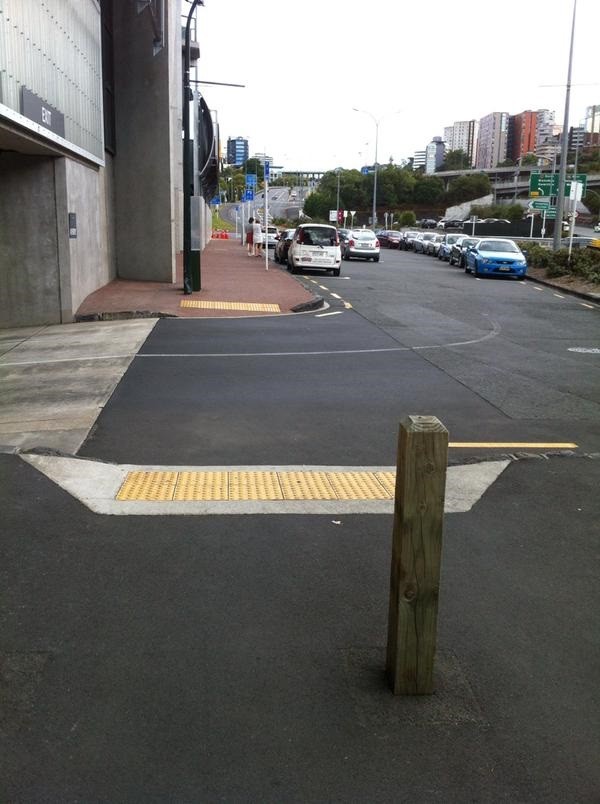
As part of developing the 2015/16 New Footpath programme the Auckland Transport Walking and Cycling team has asked for Local Board input about footpaths in the Waitematā area. 

“Missing” footpaths that Auckland Transport already has on the list are:

  • Meola Road
  • George St next to the Domain
  • Judges Bay Road extension  (connecting from the Boardwalk in the photo right to Parnell Baths) – I proposed this to AT 3 years ago
Liverpool Street
Liverpool St

I recently put the call out on twitter to help identify locations where it is currently not possible to walk safety so would benefit from investment in a new footpath.  I’ve collated the tremendous feedback so far from people who really know the streets of Auckland.

Please let me know if I have missed any more roads that need a footpath (particularly where no footpath exists at the moment – the funds available are just for new footpaths but I will also forward on the list of renewal work that has also been identified).  The final list will be prioritised by the Board and submitted to Auckland Transport by the end of June.

Cheshire StLocations needing new footpaths (where no footpath exists at the moment)

  • The Strand just east of St Georges Bay Rd
  • Wellesley Street under the Symonds St bridge
  • East side of Cheshire St in Parnell
  • Falcon St, Parnell
  • Eastern side of Grafton Road (stairs up to the slip lane also blocked)
  • Mills Lane, City Centre
  • Durham Lane, City Centre
  • Myers St, City Centre (leading to Aotea Square off Albert St)
  • Liverpool St leading into White Street and the lane access to Airedale St, City Centre
  • Mamion St, City Centre
  • Hopetown St bridge landing at Howe St
  • Cook street off ramp connecting to Union St, City Centre
  • Hargreaves St, Freemas Bay
  • Gudgeon St, Freemans
  • Maunsell St, Domain
  • Titoki St alongside the Domain
  • George St alongside the Domain (*Domain footpaths also to be considered as part of the Domain masterplan going out for public consultation in August)
Stanley Street
Stanley Street

Repair of footpaths across driveways (where pedestrians have right of way)

  • Victoria Street car park entrance on Kitchener St, City Centre
  • Entrance to the Civic car park next to Myers St off Albert St, City Centre
  • Stanley Street ASB tennis centre entrance (photo right)
  • Entrance to the UofA business school car park on Grafton rd
  • Union Street, east side north of Drake St
  • Grafton Road, hospital driveway, east side, south of Ferncroft
  • Grafton Road, hospital driveway, east side, south of Moehau St

Footpaths needing maintenance or widening 

  • Winchester St connection to Gundry St, Newton (a walking connection that has been lost to people)
  • Boston Road roundabout
  • Kerb between path and road at Khyber Pass/Grafton Station
  • Southern side of Great North Rd between St Lukes and Stadium Road
  • Bankside St, City Centre- narrow footpath
  • Fields Lane, City Centre – narrow footpath
  • Scott Street, Ponsonby

How treating pedestrians better will boost the economy 


Draft Newmarket Laneways Plan consultation

Osborne St, NewmarketIn 2009 the old Auckland City Council completed an upgrade of Obsborne St and part of Teed St. It set new design standards for the streetscape making it one of the most popular retails areas in Newmarket that has attracted private development like Osborne Lane.

The Waitematā Local Board has been working to continue the upgrade to the surrounding network of “laneways” that connect through to the new University of Auckland campus on Khyber Pass and Station Square. The project has a budget of $4m over the next three years. The Board is currently seeking feedback on the draft Newmarket Laneways Plan. The vision of this plan is to improve the quality of the side streets off Broadway and public spaces, making them safer, more inviting, more interesting and more walkable.

Newmarket consultation2At an open day today it was great to get feedback from locals and visitors who were enthusiastic about the huge potential to improve the streetscape to create a much more inviting retail environment. Parking was mentioned as an issue by many shoppers but this is perhaps because of the lack of visibility of the 9 car parking buildings currently in Newmarket. With such an abundance of off -street parking there is huge potential for what can be achieved by re-prioritising road space to cater for people.

Newmarket laneways draft plan.

Newmarket Laneways plan open day Obsorne St

Have your say by completing the online form:

Newmarket Laneways draft plan online form

This consultation closes at 5pm on 14 June 2015

Nelson Street Cycleway gets underway

Aucklanders are going to be blown away by the cycling project that got started on 23 April.  The Nelson Street cycleway will provide an off road connection from where the Grafton Gully cycleway exists on Upper Queen Street all the way to the waterfront via a bridge connecting Canada St with the old Nelson Street motorway off- ramp and a new separated cycleway down Nelson Street.  We are not far off being able to circle the city by bike. Can’t wait!

Media Release NZTA Nelson St blessing

Nelson Street Cycle Route Gets Underway

A dawn blessing has marked the start of work on the Nelson Street Cycle Route.

Kaumatua from Ngati Whatua o Orakei, Te Aki Tai, Ngati Paoa and Te Kawerau a Maki led the blessing which took place on the disused Nelson Street off-ramp.

The Nelson Street Cycle Route will link Upper Queen Street to Quay Street via the disused off-ramp and connect to the north-western and Grafton Gully cycleways, providing easier and safer access to and from the city centre.

The project will be delivered in partnership with Auckland Transport and delivered in two phases.

Nelson St blessingPhase one will see the construction of a bridge from Canada Street, connecting with the old Nelson Street motorway off-ramp and continuing as a separated two-way cycle path along the western side of Nelson Street to Victoria Street.

Construction of the bridge is first to get underway.  It will be built off-site and when completed will be put in place overnight.

Phase two will extend the separated cycle path from Victoria Street down to Quay Street and will also provide a link along Pitt Street to join Karangahape Road and Union Street.

Canada Street preparation for Nelson St off ramp bridge
Canada Street preparation for the bridge to connect to the old Nelson St off ramp

Construction of the cycleway from Canada Street to Union Street will be undertaken by Hawkins Construction. The completion of Phase one to Victoria Street is expected late this year and phase two by the middle of next year.

Canada Street bridge to Nelson St off ramp
Looking across to the old Nelson St off ramp to be connected from Canada St

First central Auckland Bikes in Schools track opens

Paul McArdle Founder Bikes in School
Bikes in Schools founder, Paul McArdle

In early 2010 Paul McArdle, founder of Bikes in Schools came to Auckland enthused from the success of the opening of the first NZ bike track in a Hastings school. At the time I was on the Cycle Action committee that was keen to support this new initiative.  Paul and I had the opportunity for a quick scout around for possible locations for a bike track in a central Auckland School.   Several schools expressed interest at the time in following up with Paul and the Bikes on NZ Trust but a combination of building projects and land constraints meant progress was slow.

So five years after the initial discussion about the possibility of a bike track in a central Auckland school it was very special to attend the opening of the new track at Freemans Bay School, the first  in the Waitemata Local Board area. The school principal Sandra Jenkins is to be congratulated for her determination in making it happen. She has been supported by the school community and a number of organisations and businesses including Sport Auckland, Cyco bike shop (who did a sharp price on the 55 new bikes), Bike in Schools, and Auckland Transport (provided bike training). The Board contributed a community grant of $2500

Hon Nikki Kaye cuts the ribbon with Freemans Bays school students

The track is available not just in school time as part of PE classes but also accessible after school and at weekends for everyone in the community to use.  At the opening it was wonderful to see how excited the kids are about the track and the opportunity to ride bikes in a safe environment.

Freemans Bay bike track opening kids on the trackWhat is also great about the track is that for the first time ever Freemans Bay School is needing to investigate bike racks as the project has encouraged kids to bike or scoot to school.


Fixing the traffic in a successful city

Fixing Auckland's transportThe Council’s consultation on the 10 year budget (Long Term Plan) has been a catalyst for a wide-ranging conversation about our city’s transport priorities and investment.  “Fixing Transport” is highlighted as one of the 4 key issues facing Auckland.

The Mayor has led the way in asking Aucklanders to consider the choices.  Do we accept a basic transport network which costs less, or do we invest more to get the advanced transport programme set out in the 30-year vision for our region known as the Auckland Plan. The Auckland Plan transport network includes the new roads, rail, ferries, busways and cycleways our city desperately needs. (From Council’s consultation material)

I was on the panel for the Auckland Conversation event  Fixing Auckland’s Transport – the 10 year budget  (as a local board member and member of the Urban Cycling Investment panel) to discuss the transport options. 

The MC Fran O’Sullivan asked panelists to consider a few points that we wished to get across. Here are mine in a bit more detail than discussed on the night . I’ve also referenced the quotes that I referred to.

What do we really mean by “Fixing” Auckland’s transport.

  •  Brent Toderian (Vancouver’s former Chief Planner and an Auckland Conversations presenter ) says “you can’t fix traffic in a successful city – you have to change it”.
  •  “fixing” is unlikely to result in “getting the traffic moving” for all trips ie there will always be congestion at peak for single occupancy private vehicles.  
  •  in order to fix transport we need to re-think mobility and provide transport choice  (As Florian Lennert presented at the the Velo city conference last year – the future of transport is “multi-modal sustainable mobility” ). If people are provided safe, effective transport choices it will create more space on the road for the vehicles that need to be there which benefits everyone. 

Efficient & smart investment

  •  The presentation of 2 stark choices has been great for forcing the debate about much needed transport investment (and I applaud the Mayor for leading that debate) but I think we have been provided with a Hobson’s choice on the 2 plans.  All the benefits for active transport/PT are locked up in the Advanced transport programme (that also included low value roading projects)
  • Either alternative funding option is going to take at least 2 years to implement so we have to get the “basic” plan right in the meantime to meet Local Board priorities.  Can’t have a basic plan that doesn’t provide for “basic” community needs. Eg There is no cycling investment in the first 3 years of the basic plan – this is unacceptable ( feedback so far shows strongest support for AT to focus more on cycling)
  • Also if cycling investment not included in the final transport programme Auckland cannot leverage off the Urban Cycling Investment Fund established last year by the Govt- there is $90m available over the next 3 years with up to 50% ear marked for Auckland if a local contribution is available
  • There is huge demand for transport choices to include cycling and there has never been a better time to invest in cycling but the current AT investment proposal in draft RLTP means Auckland is going to miss out on the funds available

The investment model

  • I agree we need funding for transport investment other than from rates but we are letting the Government off the hook. The Government needs to bring forward their contribution on the CRL and fund PT investment in the same way as state highways – this would be a game changer for the transport budget and the level of alternative funding required
  • I accept that there is a transport investment funding gap that can not be met out of rates. I support that gap being met from fuel tax as the most preferred option. From a local board perspective motorway tolling is not desirable because of the administration cost, impact on low income households and the negative impact on local roads.

Efficient & smart investment

  • Even if we agree on alternative funding I think we have been provided with a Hobson’s choice on the 2 plans.  All the benefits for active transport/PT are locked up in the alternative funding plan
  • Either alternative funding option is going to take at least 2 years to implement so we have to get the “basic” plan right in the meantime.  Can’t have a basic plan that doesn’t provide for “basic” community needs. Eg There is no cycling investment in the first 3 years of the basic plan – this is unacceptable ( feedback so far shows strongest support for AT to focus more on cycling)
  • Also if cycling investment not included in the basic plan Auckland cannot leverage off the Urban Cycling Investment Fund established last year by the Govt- there is $90m available this financial year with up to 50% ear marked for Auckland if a local contribution is available
  • Key point – there is huge demand for transport choices to include cycling and there has never been a better time to invest in cycling but the current AT investment proposal in draft RLTP means Auckland is going to miss out on the funds available

In my concluding comments I mentioned that the Waitemata Local Board has committed to being a UNICEF accredited child- friendly area. At the heart of the initiative is controlling speed and creating an environment where kids are invited to sit, play and walk.  I quoted Rodney Tolley who said at a recent Child Friendly Waitemata workshop that “a walking city is a paradise for kids” 

I think we often forget who we are building a city for and our focus should be on making the city a great place for children (so far we have let traffic engineers design it to the detriment of everyone). 

More on the transport discussion

Transport Blog – Is PT, Walking and Cycling Advocacy “Leftist” 

Submit for an essential budget 

Council’s online submission form 

Open letter to a car addicted city – Brent Toderian’s letter to Perth (but equally relevant to Auckland)

Urban Cycleways investment underway

Transport Minister Simon Bridges, Mayor Len Brown and NZTA CEO, Geoff Dangerfield

On 30 January on the old Nelson St motorway off-ramp the Minister of Transport announced the first package of projects to receive funding as part of the government’s $100 million Urban Cycleways programme. He also announced the Urban Cycleways Investment Panel that will recommend projects to the Minister.  I’m delighted to have been appointed as one of 5 panel members representing LGNZ. 

An exciting new cycleway on the redundant off -ramp (a project included in the City Centre Masterplan) connecting Upper Queen Street with Quay St via Nelson St is one of the projects to receive Urban Cycleways funding from the first tranche of projects.

Ministry of Transport Media Release: 30 January 2015

Panel Members Richard Leggert and Pippa Coom

First set of Urban Cycleways projects announced

Transport Minister Simon Bridges today announced the first $37 million worth of cycleway projects to be rolled out across the country as part of the Government’s Urban Cycleways Programme.

First announced in August 2014, the $100 million Programme is designed to pull together a range of funding sources to invest in expanding and improving New Zealand’s cycling network.

“This is the beginning of a programme that will change the face of cycleways in New Zealand using clever funding leveraging.

By pulling together multiple funding sources, the Urban Cycleways Programme will get high-quality projects underway much sooner than may otherwise have been the case.

The Government’s Urban Cycleways Fund will contribute $9.92 million, with

Nelson St off ramp before/after - City Centre Masterplan image
Nelson St off ramp before/after – City Centre Masterplan image

another $21.12 million coming from the National Land Transport Fund, and $6.26 million from local government and other contributions,” Mr Bridges says.

This year, those sources have made available a total of $37,295,000.

When completed, the Urban Cycleways Programme will have supported the investment of up to $320 million, over four years, to create a safe, user-friendly cycleway network across the country.

“The Urban Cycleways Fund will accelerate the first set of 13 projects, which will get underway in Auckland, Hamilton, Palmerston North, Wellington, Christchurch and Dunedin, and almost all will be completed over the next 6-9 months,” Mr Bridges says.

“The projects I am announcing today have been prioritised because of their value to commuter cyclists, and their additional benefits to recreational riders.

“Further projects to receive funding from the remaining $90 million in the Urban Cycleways Fund will be announced later this year,” Mr Bridges says.

Urban Cycleways Programme projects are decided by the Minister of Transport, on the recommendation of the Urban Cycleways Investment Panel.

The Panel has been selected to assess the projects and prioritise funding.

The Panel members are:

  • Cynthia Bowers, Deputy Mayor of Hastings
  • Glen Koorey, Senior Lecturer in Transportation Engineering at the University of Canterbury
  • Richard Leggett, Director of Cycling NZ and Chair of the Cycling Safety Panel
  • Pippa Coom, Deputy Chair of the Waitemata Local Board
  • Mike James, General Manager Road and Rail, Ministry of Transport
  • Dave Brash, Group Manager Planning and Investment, New Zealand Transport Agency.

For further information on the Urban Cycleways Programme the , visit:www.transport.govt.nz/cityrides

Projects to be accelerated in 2014/15:

Urban-Cycleway-Funding-Jan-15

Media release: Pohutukawa savers

Sunday 18 January 2015

Pohutukawa Savers to Attend Public Meeting

Pohutukawa Savers will be out in force at the SH16 St Lukes Interchange Upgrade community liaison meeting on Tuesday evening, 20th January, to highlight the imminent threat to six heritage pohutukawa opposite MOTAT, five of which are at least 80 years old.

A growing alliance of concerned residents from all walks of life and from across the region, the Pohutukawa Savers invite key decision-makers from Auckland Transport to front up and listen to community concerns. The meeting will be held at 6pm in the Western Springs Community Garden Hall – ironically, just down the road from the trees the group aims to save.

 Auckland Transport claims the trees must go to make space for its preferred intersection design that creates a second turning lane into St Lukes Road. The Pohutukawa Savers believe the trees can be retained via an improved design that also satisfies traffic requirements. They intend to vigorously appeal Auckland Transport’s decision to the Environment Court.

Pohutukawa Savers spokesperson Jolisa Gracewood says, “These grand old trees are a vital element of the area’s history and living heritage. They were planted in 1934 as part of a continuous avenue of pohutukawa along Great North Road, to beautify the newly created public greenspace as a gift to the citizens of Auckland. As such, they belong to all Aucklanders, and are located on open park land under the responsibility of the Waitematā Local Board.”

“These trees form a spectacular streetscape that welcomes visitors to the Western Springs parks precinct. Trees of this stature are crucial to the urban ecosystem, providing shade, air-filtering and stormwater dispersal, as well as a habitat for native birds. People all over Auckland, and beyond, are aghast at their proposed destruction. The spontaneous joy with which people have decorated the trees since hearing about their possible fate shows how valued they are.”

“Sacrificing these healthy, monumental trees would be a hasty, irreversible loss for little demonstrable gain. We know Auckland Transport has workable alternatives to this ‘either/or scenario’, and we believe that smart design can solve the traffic questions while preserving the historic and visual integrity of the space. We are asking Auckland Transport to recognise the value of these trees to Aucklanders of yesterday, today and tomorrow — and to help create a more liveable city by embracing a 21st century design that saves the trees.”

The meeting will be held on Tuesday 20 January at 6pm at the Western Springs Community Garden Hall, Great North Road. All who wish to support the trees are encouraged to attend.

Comment:

Jolisa Gracewood ph 027 513 5923

Christine Rose ph 021 056 3784

The Pohutukawa Savers are an alliance of residents, arborists, engineers, lawyers, and tree-lovers. They administer a Facebook page (2425 likes as of 18 January 2015) at www.facebook.com/savethepohutukawa6/, a Twitter account at @pohutukawa6 with 468 followers, and an online petition which has gathered 1912 signatures from across the country (as of 18 Jan 2015): https://www.change.org/p/auckland-transport-save-the-6-pohutukawa-trees-on-the-corner-of-st-lukes-rd-and-great-north-rd

Remembering Malcolm (Mel) Coom: Speed limit enforcement will save lives

Pippa Coom, Malcolm Coom and Adam Coom Dec 1991
Me, my dad Malcolm Coom and brother Adam. December 1991

Just over twenty years ago my generous, fun loving, warm hearted dad was making plans for an overseas trip. He regularly visited the UK (where his parents lived) but this time he was especially excited about including lots of dancing into his travels leading up to the Rio Carnival. My dad loved to dance Latin American style and was a regular at the old El Inca club on K’rd.

Before he left for the UK he set out on a roadie to visit me in Wellington where I lived at the time. He never made it. At Sanson on SH1 he missed the turn off to Wellington and a few minutes later along SH3 he was killed instantly in a head on crash.

He was 49.

Many years later and now with a role on the Waitematā Local Board advocating for road safety, I’ve come to think of the crash not just as a personal family tragedy but also how it provides an understanding of the “safe systems” approach to creating a forgiving roading network.

Every part of the system failed my dad.

The Road: The signage on SH1 used to be terrible. It was easy to miss the turnoff at Sanson like my dad did. Shortly after the crash Transit upgraded the signage.

The crash occurred where an overtaking lane abruptly ends at the brow of a hill.

Road Use:  The driver of the on- coming car pleaded not guilty (I think the charge was careless driving). He couldn’t remember the crash and could not believe that he had caused it. He thought of himself as a safe driver who was very familiar with the stretch of road.

The Vehicle: My dad loved old cars (unlike his dad who after a working life in the Vauxhall factory in Luton was able to upgrade his car every year). The old Rover he was driving didn’t have any driver safety features like air bags.

Speed: The other driver made a mistake misjudging a simple over taking move in a passing lane. Unfortunately his speed gave him no time to react when he found himself on the wrong side of the road.

Even the best drivers make mistakes. What we don’t have to accept is that fatalities and serious injuries are just an inevitable consequence of driver mistakes. A safe system approach means that we can demand a lower road toll and even zero road deaths (“Vision Zero“)  but we all have to play our part.  We need improved road design, safer vehicles, competent road users and safe speeds.

The NZ Police are currently under pressure to get their messaging right about their approach to enforcing the speed limit and need to explain why the road toll has increased during the holiday period (when the trend is downwards). However I absolutely back the Police taking a hard line on speed enforcement (with the posted limit recognised as the limit without fiddling with “tolerances” rounds the edges) . It is a lazy political response to claim  (as Ron Mark MP has done) that speed management is about revenue gathering. It is based on international evidence that reducing speeds reduces the number and severity of crashes.

If anything I would like to see the Police put even more resources into enforcing urban speed limits.  The Waitematā Local Board is advocating for slower speeds in residential areas (starting with a trial) and supports the City Centre Masterplan objective of a central slow speed zone.  Reducing speeds will contribute to liveability and encourage more people to walk and cycle.  And of course easing back on the gas will save lives [2026 edit:  And save money!] . 

Safe systems approach explained

Stop the “blame game” – improving road culture in NZ 

Edinburgh to roll out 20mph speed limit across city

The Safe System approach aims to create a forgiving road system based on these four principles:

  1. People make mistakes

People make mistakes and some crashes are inevitable.

  1. People are vulnerable

Our bodies have a limited ability to withstand crash forces without being seriously injured or killed.

  1. We need to share responsibility

System designers and people who use the roads must all share responsibility for creating a road system where crash forces do not result in death or serious injury.

  1. We need to strengthen all parts of the system

We need to improve the safety of all parts of the system – roads and roadsides, speeds, vehicles, and road use so that if one part fails, other parts will still protect the people involved.