Monthly board report March 2016

This report covers my Waitematā Local Board activities from 1 February – 29 February 2016 as Deputy Chair, lead for the Community and Transport portfolios, and Chair of the Grants Committee, and with positions on the Ponsonby Business Association Board and Ponsonby Community Centre Committee and Board liaison for the Parnell Community Centre.

Portfolio Updates

Community Empowerment
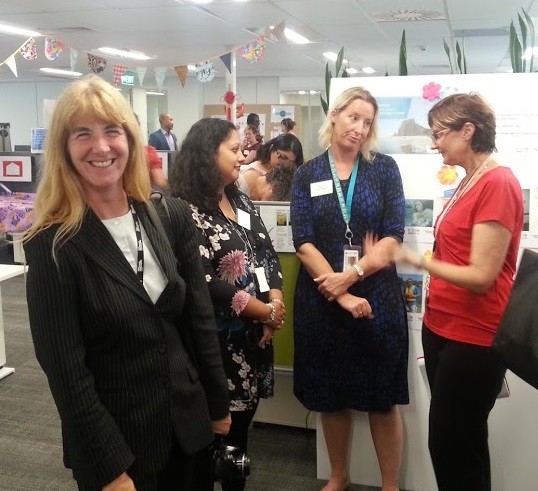
Cr Cathy Casey at Community Empowerment unit open day

Since October 2015 Auckland Council has been in the process of implementing an empowered communities approach to community development. The new operating model involves a shift from Council delivering community development activities, to using community-led development processes.  The new approach requires Council’s operational practices to allow more people to participate and for budgets to be devolved to communities as much as possible.

The Board has been supportive of the change in approach and we welcomed our new Strategic Broker Shamila Unka at the end of last year. Shamila will be based part time at the Board’s new offices at 52 Swanson Street.

We have however been concerned to ensure a smooth transition and that none of the local board’s priorities are over looked in the new structure.

The leadership team of the new Community Empowerment Unit led by Christine Olsen met with the central area community development portfolio holders in early February and the whole Unit held a very informative Open Day for all elected representatives on 29 February 

Community development work programme

  • Priorities of the community development portfolio for 2016 include:
  • Review and refresh of the Board’s accessibility plan
  • Support for Council’s Homeless Action Plan
  • Continuing the upkeep of Waitemata’s community facilities
  • Transitioning community centres to 3 yearly agreements
  • Supporting the work of the Waitematā Youth Collective and development of a city centre youth hub
  • Provision of temporary meeting spaces in the city centre during the Ellen Meville Hall upgrade period
  • Child Friendly City Accreditation
  • Supporting community empowerment projects such as the community- led design process for 254 Ponsonby Road

Community consultation – Annual budget 2016/17

Annual budget 16The Council’s annual consultation on the budget for the following year got underway in mid-February.  As part of the process the Board also seeks feedback on our local priorities and new proposals.

Waitematā Local Board key priorities outlined in the consultation material: Based on our 10-year budget, in 2016/2017 we plan to invest $11 million to renew and develop assets in your local board area and $23 million to maintain and operate these assets and provide other local initiatives. This includes:

  • renewing existing assets ($2.4 million)
  • completing stage two of Myers Park including the improved entranceway at Mayoral Drive and installation of a splash pad ($3.3 million)
  • completing the Weona-Westmere coastal walkway ($360,000)
  • re-developing Pioneer Women’s and Ellen Melville Hall ($3.4 million)
  • commencing delivery of a streetscape improvement project from the agreed Newmarket Laneways Plan ($1.4 million)
  • delivering the new Fukuoka gardens in Western Springs park ($40,000)

It is proposed the following additional local priorities for 2016/2017 are funded through local discretionary budgets:

  • improve the pathways through Western Park and upgrade the Pt Resolution steps to concrete
  • install a new pathway through Symonds Street Cemetery to connect Karangahape Road to Grafton Gully cycleway
  • increase spend on low carbon initiatives to help Waitematā lower carbon use and become more energy-resilient including the installation of photovoltaics at Grey Lynn Community Centre
  • increase the budget for the annual Myers Park festival to provide an even better local event
  • investigate the feasibility of establishing a youth hub in the city centre
  • install a solar heating solution at Parnell Baths
  • continue to put children and young people first and achieve UNICEF Child Friendly City accreditation
  • support community-led development and place making such as the open space design for 254 Ponsonby Road and the development of a bicycle pump track at Grey Lynn Park

The Board is also considering allocating budget to change the service levels to increase maintenance of headstones and removal of graffiti at the historic Symonds Street Cemetery.

I’ve raised concerns with the regional consultation team about the poor level of communication to promote local board consultation events and the inaccessibility of the material online.

Fortunately we have a fantastic local board team who have been doing a great job on our behalf working alongside local community groups to arrange consultation events and opportunities to give feedback.

Due to a range of issues with promoting the Annual Budget 2016/17 consultation material the feedback period has been extended to 24 March.  Link to the online feedback form 

Transport

At our first transport portfolio meeting of the year we discussed a long list of updates with Auckland Transport representatives including:

  • Ponsonby Road pedestrian experience project:  The proposals for improving Ponsonby Road for people walking were consulted on from from 16 November to 7 December 2015. In total, 129 feedback responses were received with a large majority expressing strong support for the project overall.  The results and recommendations for next steps will be reported back on our April agenda.
  • Cycleway progress and implementation with Kathryn King, Manager of Walking & Cycling: AT plans to seek feedback in March from Western Bays residents on preferences for making the area more attractive for cycling. We raised the issue of the many outstanding small fixes to the existing cycle way network that we are concerned are getting forgotten with the focus on an extensive capital work programme. It was good to hear that many are underway such as contra- flows for cycling on one way streets including Crummer Road (first included in our Local Board Agreement 2011/12)
  • Quay St cyclewayQuay Street update: The design for a two-way separated cycleway on Quay Street leading from Lower Hobson Street, past Princess Wharf to Plumer Street has been confirmed. Completion is expected in April 2016
  • CRL update: Options are being considered for closing the rail crossing on Porters Ave just off New North Road on the boundary of the Waitemata Local Board area. This has an impact on the residents and businesses of Albert – Eden.
  • Nelson Street parking: Auckland Transport consulted the transport portfolio before removing the parking on Nelson St between Wellesley and Victoria Streets alongside
    Parking on Nelson Street
    Parking removed from Nelson St

    the cycleway (photo right). We didn’t object to the removal as occupancy was low and the poor layout was causing a lot of confusion for drivers. However we did ask AT to actively work with the NZ Police to enforce the speed limit on Nelson St (the parked cars had the benefit of slowing down the traffic).

  • Private Planting in Road Corridor: AT’s long awaited berm planting guidelines are expected to come back to Local Boards for comment shortly
  • Parking Fund Reserve: Approximately $100k is available to fund car parking. The transport portfolio has asked that a proposal to leverage this fund to develop sites that are in Council ownership while retaining off street car parking be investigated (for example the car park on Pompellier Tce)
  • Local Board Transport Capital Fund has $216k available that needs to be allocated by October. The Board is exploring a number of options with Auckland Transport

The Auckland Transport monthly report on our agenda provides updates in more detail.

Street Trees
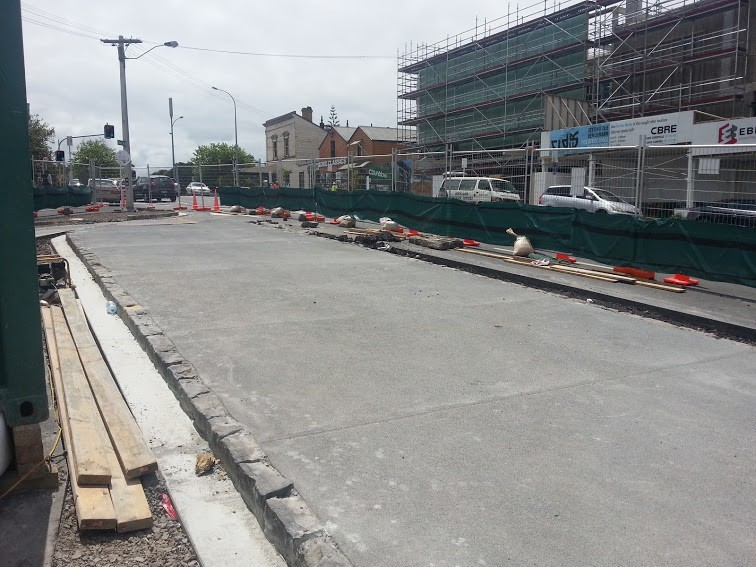
Williamson Ave Rose RoadThe gutting of tree protection regulations by the government has highlighted the importance of street trees for providing the many benefits the city receives from a rich green canopy. Unfortunately Auckland Transport has generally been taking a “business as usual” approach to footpath upgrades and renewals so that opportunities to plant trees have been overlooked.

Part of the problem appears to be an institutional resistance to including trees because of the additional operational costs.

Five recent projects have exposed the need for Auckland Transport and Auckland Council to urgently agree on the policy and procedure for the planting of street trees:

  • Graham Street footpath renewal
    Graham Street footpath renewal

    Rose Road road works as a result of the new Countdown supermarket on Williamson Ave – footpath extended without tree pits (photo top)

  • Graham St footpath renewal – footpaths reinstated without tree pits (photo below)
  • Scotland Street upgrade – plans for greening the footpath build-out are still in discussion
  • Parnell Rise/ Parnell Road upgrade – plans for greening the footpath build-out are still in discussion. A tree pit was not originally included in the design because of underground utilities
  • The Dylan apartment development on the corner of Great North Road and Harcourt St- footpaths reinstated without tree pits

One piece of good news is that following our advocacy and a series of complaints Auckland Transport and the Council’s arborist were able to agree on the inclusion of 4 new tree pits on the footpath between Rose Road and Williamson Ave (issues regarding the development contribution for undertaking the remedial work and how a giant area of concrete was installed without trees in the first place are still to be resolved).

City Centre Master plan review – first steps towards Vision Zero Auckland

The City Centre Master Plan (CCMP) was published in 2012 with nine outcomes and 36 targets. The Waitematā Local Board contributed to a review of the plan leading to new outcomes and targets being signed off by the Auckland Development Committee on 11 February 2016.

I am really pleased that following a request from the Board Outcome 7 has had the words ‘moving towards zero pedestrian deaths or serious injuries as a result of vehicle collisions’ added. This is a significant contribution to road safety and is the first time the principle of “Vision Zero” has been adopted under Auckland Council.

LGNZ meeting

I attended the Zone 1 meeting in Whangarei on 26 February for Local Government NZ delegates in the Auckland and Northland area.

We received presentations from Malcolm Alexander, CEO of LGNZ and Ernst Zollner, Regional Director of NZTA.

An issue I brought up at the zone meeting was my disappointment and incredulity (shared by many elected representatives) that LGNZ has announced a conference programme with zero female presenters. It is also surprising that a conference on the theme of “place making” appears to offer so little for Local Board members.  It highlights to me that LGNZ is still struggling to respond to Auckland’s governance arrangements that established local boards representing more people than Dunedin.

Workshops and meetings

From 1 February – 29 February 2016 I attended:

  • Waitematā Local Board workshop on 2 February
  • Meeting to discuss the Board’s participation in Neighbours Day
  • Auckland Transport meeting with representatives of Franklin Road residents to discuss the planning and timetable for the upgrade that is about to get underway
  • Waitematā Local Board business meeting on 9 February in Grey Lynn
  • Ponsonby Business Association Board meeting on 10 February
  • Waitematā Local Board workshop on 11 February
  • Draft domain master plan open day on 13 February (see Attachment A)
  • Waitematā Local Board workshop on  16 February
  • Monthly Transport portfolio catch up on 17  February
  • Community portfolio meeting on 18 February
  • Community Empowerment Unit and Local Board Central Cluster Portfolio Holder meeting on 18 February to meet the new leadership team of the Unit
  • Waitematā Local Board workshop on 23 February
  • Annual Budget 2016/17 consultation meetings:
  • Western Bays Community Group AGM and presentation
  • Grey Lynn Residents Association meeting
  • Parnell Community Committee meeting
  • Inner City Network meeting
  • Meeting to discuss the development of the Uptown Business Association brand on 24 February
  • Attended the Governing Body extraordinary meeting to discuss the “out of scope” Unitary Plan zoning proposals
  • Richmond Rovers Community meeting on 24 February to discuss the club’s alcohol licence with local residents
  • BID policy workshop with representatives from Ponsonby Business Association and Parnell Inc
  • LGNZ zone 1 meeting on 26 February in Whangarei
  • Community Empowerment Unit’s open day on 29 February

Events and functions

From 1 February – 29 February 2016 I attended:

  • Associates breakfast – urban design, cycling and transport discussion on  4 February at Scarecrow café
  • Joined the anti- TPPA protest on 4 February
  • Attended the Waitangi celebrations at Takaparawha as a zero waste volunteer with Christopher Dempsey on 6 February
  • Go by Bike Day pit stop on the Lightpath on 9 February
  • Phantom of the Opera at the invitation of ATEED on 11 February
  • The Book of Everything at Q Theatre at the invitation of Silo Theatre on 12 February
  • Rock in Grey Lynn Park on 13 February (free music in parks event)
  • Polo at Sky Theatre at the invitation of the Auckland Theatre Company
  • The Big Gay Out in Coyle Park on 14 February
  • Elected representatives and Local Board staff lunch time ride for the Auckland Bike Challenge on 18 February 
  • Auckland Philharmonia Grand Opening concert at the Auckland Town Hall on 18 February at the invitation of APO
  • Lantern Festival opening function at Auckland Museum on 19 February
  • Opening of Parnell Trust’s new offices in the Jubilee building, Parnell on 23 February
  • Grey Lynn Business Association networking drinks
  • Blessing for the Board’s new offices at 52 Swanson Street on 25 February
  • The Board supported Myers Park Medley on 27 February 
  • Official party at the Citizenship ceremony in the Town Hall on 29 February
Members of the Waitemata Local Board and Local Services staff on a lunchtime bike ride for the Auckland Bike Challenge

Monthly Board report July 2015

This report covers my Waitematā Local Board activities from 1 June – 7 July 2015 as Deputy Chair, lead for the Community and Transport portfolios, Chair of the Grants Committee, and with positions on the Ponsonby Business Association Board, Ponsonby Community Centre Committee and Board liaison for the Parnell Community Centre.

I have also been acting Chair from 19 June – 10 July.

HIGHLIGHTS

Costley Reserve playground opening on 27 June

Costley Reserve playground board members at the opening


 Urban Cycleways programme

Auckland urban cycleways Since December 2014 I have been a member of the Urban Cycleways Investment Panel.  The Panel considered proposed cycleway projects that Councils from across the country put forward for funding from the $100m urban cycling fund, and provided recommendations to the Minister of Transport on the final Urban Cycleway Programme.

On 25 June I attended the launch of the programme by the Prime Minister and Minister of Transport in Rotorua (see Attachment A). On the same day as the launch the governing body signed off the Long -Term Plan budget including the local share of a $124m three year walking and cycling programme which should deliver 52 kilometres of new cycleways.

This is great news especially for the Waitematā Local Board area. After many years of the Board advocating for dedicated cycleways and the completion of the Auckland Cycle Network we will see the acceleration of projects with safe connections on Great North Road, Surry Crescent, Gladstone Road,  a Western Connection via Sarsfield St together with city centre routes.

 Auckland Council’s Long Term Plan

Newmarket laneways open dayThe 10-year budget that was adopted on 25 June by the governing body includes the funded priorities for each local board. The Waitematā Local Board consulted on the following proposals for the next 10 years:

  • complete the Weona-Westmere Coastal Walkway
  • upgrade Newmarket Laneways public realm to provide a safer and more vibrant environment for pedestrians and shoppers
  • deliver the Western Springs Native Bush Restoration Plan
  • redevelop Pioneer Womens and Ellen Melville Hall as a city centre community hub
  • continue the delivery of the Waipapa Stream restoration and ecological project
  • support local community services, events and grants
  • continue to deliver initiatives from our local board plan.

Of the 1,412 submissions received, 745 made comments on the local proposals. Overall the majority of these respondents supported the local proposed projects for 2015/2016 and 2016-2025. In particular, there was support for the implementation of the Waipapa Stream and the Western Springs native bush restoration, the completion of the Weona-Westmere walkway and delivery of local events. There was also strong opposition towards reducing local library opening hours.

After considering the feedback, the board has funded the proposals listed above, and has reduced the budget from $100,000 to $75,000 for a temporary arts and culture POP  programme for which there was lower support. The Board has also allocated funding to support increasing Grey Lynn Library’s opening hours by half an hour a week. (refer Auckland Council media release Attachment B)

Skypath

Resource consent for the walking and cycling pathway over the Auckland Harbour Bridge (Skypath) was granted on 3 July.  This is a significant milestone in a 10 year long campaign to establish this critical link in Auckland’s cycling network.

The Waitematā Local Board has consistently supported the Skypath project. (Photo right from the Get Across protest in 2009 when thousands enjoyed walking and cycling over the bridge)

Grandstand driveGrandstand Drive improved for people to enjoy the Domain

It is surprisingly difficult to move around the Domain without coming into conflict with cars or running out of footpath so it is great to see the parks team have closed the parking on Grandstand drive (due to the risk posed by the oak trees). This is hopefully the start of many further improvements that will progress through the Domain masterplan (to be consulted on in August) and the Museum’s work to improve walking connections.

New footpath programme 15/16

The Transport portfolio provided input to Auckland Transport’s new footpath work programme 15/16.  In Attachment C I explain how I finalised a list of locations with assistance from the public. 

Tactical Urbanism workshop

I attended a workshop with Mike Lydon, Principal Street Plans Collaborative – New York to and author of Tactical Urbanism: Short-term Action for Long-term Change, a book that shares techniques for ambitiously jump starting projects in the urban realm.

tree pit Great North RdThe workshop (hosted by Waterfront Auckland, Auckland Council and Auckland Transport) focused on the opportunities afforded by tactical urbanism, how the ‘lighter, cheaper, faster’ methodology can better deliver desired outcomes for the city, what obstacles lay in the way of achieving the desired outcomes and how we best work together to mitigate these obstacles and achieve the vision for Auckland as the world’s most liveable city. 

The city centre team have a budget of $800k for tactical urbanism projects like pop-up parks. It is great to see that many examples of “tactical urbanism” are already springing up in the community without any support from Council (for example the tree pit in the photo was recently planted after being empty for some time).

New initiative: Vision Zero

Fanshawe StreetTragically Mr Robert Su was killed on Fanshawe St on 2 June (early indications are that he was crossing at the pedestrian crossing with the green man when he was hit by a speeding truck).    In Attachment D I outline why I think the time has come for Vision Zero Auckland.

Not long after the crash on Fanshawe St Auckland Transport started a misguided and patronising “cross safely with the green man” campaign aimed at the victims of traffic violence. I have raised my concern with Auckland Transport that this kind of approach is shown not to be effective and that resources should be directed at measures that improve pedestrian safety (eg road design, enforcement, speed reduction).

 Workshops and meetings

From 1 June to 7 July I attended:

  • Waitematā Local Board workshop on 2 June
  • Two days of the Skypath resource consent hearing
  • Visit to the Art of remembrance installation at St David’s church to meet Paul Baragwanath, Trustee Friends of St David
  • Communications update with the Local Board communications advisor
  • Engagement adviser update
  • Draft Newmarket Laneways plan open day on Osborne St, Newmarket on Saturday 6 June
  • Waitematā Local Board business meeting on 9 June in Parnell
  • Ponsonby Business Association Board meeting on 10 June
  • Waitematā Local Board workshop on 11 June
  • Draft Newmarket Laneways plan- Stakeholder Workshop at the Rialto Cinema on 11 June
  • Waitematā Local Board workshop on  16 June
  • Community Meeting  on Western Park Development Plan consultation feedback on 16 June
  • Newmarket Laneways Member Working Group Update on 17 June
  • Monthly Transport portfolio catch up on 17  June
  • Meeting to discuss up- coming playground openings
  • Tactical Urbanism workshop with Mike Lydon hosted by Waterfront Auckland  on 22 June
  • Local Board Chairs Forum on 22 June
  • Waitematā Local Board workshop on 23 June
  • Meeting with Ponsonby Business Association reps to discuss parking proposals
  • Franklin Road residents meeting hosted by Auckland Transport to discuss progress on the upgrade of Franklin Road on 23 June
  • Elected member professional development working group meeting
  • Central joint funding committee reestablishment meeting with representatives from Albert-Eden, Orakei, Maungakiekie-Tamaki and Puketapapa Local Boards
  • Senior Advisor/ Relationship manager weekly chairs meeting
  • Ponsonby Community Centre management committee meeting
  • Waitematā Local Board workshop on 30 June
  • Meeting to discuss Auckland Transport’s wayfinding signage proposals
  • Auckland Cycle Forum on 30 June at GridAKL
  • Community Development portfolio monthly update on 1 July
  • Meeting with Matt Ball, Ports of Auckland to discuss proposed Rainbow Warrior memorial art installation
  • Lunchtime learning: Auckland’s Green Lifeline – presentation by Andrea Reid about a new movement that aims to connect Auckland’s parks and reserves together to make pollination pathways.
  • Visited the homelessness Wānaga at Tātai Hono Marae, Grafton hosted by Te Puni Kokiri for Matariki

 Events and functions

Parnell Baths book launchFrom 1 June – 7 July attended:

  • Parnell Baths book launch at the Parnell library on 4 June (photo right)
  • Italian National Day piano concert at the invitation of Dante Alighieri Auckland
  • Parnell Heritage and RSC-Anzac Celebration with member Greg Moyle as guest speaker at the Parnell RSC
  • Kiss the Fish at Q Theatre at the invitation of Indian Ink Theatre Company
  • Waipapa Stream planting day on Saturday 13 June
  • Waipapa planting day July 2015Waitemata Local Board Good Citizen Awards at the Town Hall on 17 June
  • Newmarket Business Association business awards at the Auckland museum at the invitation of the NBA on 19 June
  • Launch of Greater Auckland on 21 June at Golden Dawn
  • Launch of the Urban Cycleways Programme in Rotorua on 25 June
  • Costley Reserve playground opening on 27 June
  • Breakfast celebration at the Zoo to welcome the new elephant Anjalee at the invitation of Regional Facilities Auckland
  • Associates breakfast – urban design, cycling and transport discussion on 2 July at the Auckland Art Gallery
  • Auckland Conversation: Mary Jane Jacob Public Art – what is it good for? on 2 July at St James Theatre
  • Opening of the World Press Photography exhibition at Smith & Caughey on 3 July
  • Skypath resource consent approval celebration at the Northcote Tavern on 3 July
  • Pecha Kucha cycling edition on 7 July at Shed 10 hosted by Auckland Transport

 pecha kucha cycling edition Barbara Grace


Vision Zero for Auckland

Fanshawe StreetOn 2 June 2015 Robert Su, 33 was heading home from work at the ASB bank to his family in Hillcrest. Like hundreds of commuters he was walking from Wynyard Quarter to the bus stops on Fanshawe Street. Tragically while crossing the road he was struck by a truck and killed. The exact details of the crash have not been released but it is highly likely that a range of factors were involved – speed, driver error, vehicle design,  road design, weather conditions. Flowers have been placed in memory of Mr Su at the pedestrian crossing.

The day after Mr Su’s death a woman was killed in Orewa as she crossed the road marking a week when two pedestrians were also seriously injured and a rider on his way to work was almost killed.  So far this year 14 pedestrians have been killed in NZ, 4 in the Auckland area.

Photo credit: @ByTheMotorway

What I find particularly tragic and frustrating about Mr Su’s death is that the road he was expected to cross is designed like a motorway for speed and traffic efficiency. For drivers coming off SH1 there are no clues that Fanshawe St is the gateway to the central city. For some time office blocks have been going up near by but no changes have been made to the road to respond to changing land use and the growing numbers of people walking (and cycling) through the area.

At a time when the Auckland Council family of organisations is working to make the city the most liveable in the world through a whole range of transformational projects we continue to let down our most vulnerable road users.   Improvements are definitely underway (eg removal of slip lanes in the city centre, complete street upgrades) and various campaigns take a safe systems approach to road safety supported by the NZ Police but what I think is missing is a comprehensive, everyone on board, Vision Zero  response where we, collectively as a city, do not consider any fatalities or serious injuries are acceptable or inevitable.

Letter to the NZ Herald 15 June 2015
Letter to the NZ Herald 15 June 2015  

I think Auckland needs to officially adopt Vision Zero (as the Mayor of NYC did in January 2014 ) with a clear action plan.  It will need support from politicians, traffic engineers, transport agencies, all road users and grassroots campaigners. Most importantly it will require a huge culture shift in our attitudes to driving  and acceptance that managing speeds is at the heart of improving safety.

There is strong community support for improving public transport and providing greater opportunities for active travel (as indicated by feedback on the Auckland Council’s Long Term Plan) but too often resistance if this means slowing down drivers. It is far too common to hear complaints that speed enforcement is “revenue raising” and politicians shy away from taking decisive action on speed control in the face of evidence and the recommendation of safety experts. 

 Vision Zero AKL – embracing street design, slower speeds, rules changes,  education and enforcement -I think could provide the right platform for far greater public support for the concept of putting the safety of people first.

In the meantime I think there is the need for immediate action focused on city centre streets so that no one needs to be put at risk of getting killed on their way home from work.

Fanshawe Street missing ped leg
Photo credit: @BytheMotorway
  • Remove motorway signage from Fanshawe St
  • Install the missing pedestrian crossing at the intersection of Fanshawe St and Halsey St (this needs to happen before the new Fonterra HQ opens)
  • Enforce the speed limit particularly on “motorway” style city streets like Fanshawe, Hobson and Nelson
  • Implement the 30km/h speed limit for the City Centre and Wynyard Quarter (as proposed in the City Centre masterplan)
  • Repair the urban fabric of the city where footpaths connections are missing 
  • Target road safety campaigns

(this is my initial list as a non expert – I am sure there are many more actions requiring immediate attention)

Update 17 July 2016 

I’ve joined the call to for Vision Zero to be adopted for NZ to bring down road toll 

More reading

 Five key lessons from Europe’s Vision Zero Success

1) Managing speeds — and speed differentials — is a top priority

In all three of these countries, the leaders of traffic safety efforts emphasize that managing speed is the number one determinant in their successes in improving safety.

Over the past 15 years, the national governments of Sweden, the Netherlands, and Germany have all proactively and systematically changed their approaches to speed. Each nation (to differing degrees, but all significantly) has lowered speed limits for a clearly defined hierarchy of roads and corresponding speeds. For instance, the Netherlands has shifted…

  • from 50 kilometers per hour (kph) to 30 kph on smaller, residential streets;
  • from 70 kph to 50 kph on bigger, or what we’d consider arterial roads; and
  • from 100 kph to 70 kph on the freeway-like roads outside cities.

In each of the three nations, nearly everyone I’ve spoken with credits speed management as the greatest contributor to their success in improving safety on the streets and saving more lives.

Remembering Malcolm (Mel) Coom: Speed limit enforcement will save lives

Pippa Coom, Malcolm Coom and Adam Coom Dec 1991
Me, my dad Malcolm Coom and brother Adam. December 1991

Just over twenty years ago my generous, fun loving, warm hearted dad was making plans for an overseas trip. He regularly visited the UK (where his parents lived) but this time he was especially excited about including lots of dancing into his travels leading up to the Rio Carnival. My dad loved to dance Latin American style and was a regular at the old El Inca club on K’rd.

Before he left for the UK he set out on a roadie to visit me in Wellington where I lived at the time. He never made it. At Sanson on SH1 he missed the turn off to Wellington and a few minutes later along SH3 he was killed instantly in a head on crash.

He was 49.

Many years later and now with a role on the Waitematā Local Board advocating for road safety, I’ve come to think of the crash not just as a personal family tragedy but also how it provides an understanding of the “safe systems” approach to creating a forgiving roading network.

Every part of the system failed my dad.

The Road: The signage on SH1 used to be terrible. It was easy to miss the turnoff at Sanson like my dad did. Shortly after the crash Transit upgraded the signage.

The crash occurred where an overtaking lane abruptly ends at the brow of a hill.

Road Use:  The driver of the on- coming car pleaded not guilty (I think the charge was careless driving). He couldn’t remember the crash and could not believe that he had caused it. He thought of himself as a safe driver who was very familiar with the stretch of road.

The Vehicle: My dad loved old cars (unlike his dad who after a working life in the Vauxhall factory in Luton was able to upgrade his car every year). The car he was driving (I think a Rover) didn’t have any driver safety features like air bags.

Speed: The other driver made a mistake misjudging a simple over taking move in a passing lane. Unfortunately his speed gave him no time to react when he found himself on the wrong side of the road.

Even the best drivers make mistakes. What we don’t have to accept is that fatalities and serious injuries are just an inevitable consequence of driver mistakes. A safe system approach means that we can demand a lower road toll and even zero road deaths (“Vision Zero“)  but we all have to play our part.  We need improved road design, safer vehicles, competent road users and safe speeds.

The NZ Police are currently under pressure to get their messaging right about their approach to enforcing the speed limit and need to explain why the road toll has increased during the holiday period (when the trend is downwards). However I absolutely back the Police taking a hard line on speed enforcement (with the posted limit recognised as the limit without fiddling with “tolerances” rounds the edges) . It is a lazy political response to claim  (as Ron Marks MP has done) that speed management is about revenue gathering. It is based on international evidence that reducing speeds reduces the number and severity of crashes.

If anything I would like to see the Police put even more resources into enforcing urban speed limits.  The Waitematā Local Board is advocating for slower speeds in residential areas (starting with a trial) and supports the City Centre Masterplan objective of a central slow speed zone.  Reducing speeds will contribute to liveability and encourage more people to walk and cycle.  And of course easing back on the gas will save lives. 

Safe systems approach explained

Stop the “blame game” – improving road culture in NZ 

Edinburgh to roll out 20mph speed limit across city

The Safe System approach aims to create a forgiving road system based on these four principles:

  1. People make mistakes

People make mistakes and some crashes are inevitable.

  1. People are vulnerable

Our bodies have a limited ability to withstand crash forces without being seriously injured or killed.

  1. We need to share responsibility

System designers and people who use the roads must all share responsibility for creating a road system where crash forces do not result in death or serious injury.

  1. We need to strengthen all parts of the system

We need to improve the safety of all parts of the system – roads and roadsides, speeds, vehicles, and road use so that if one part fails, other parts will still protect the people involved.