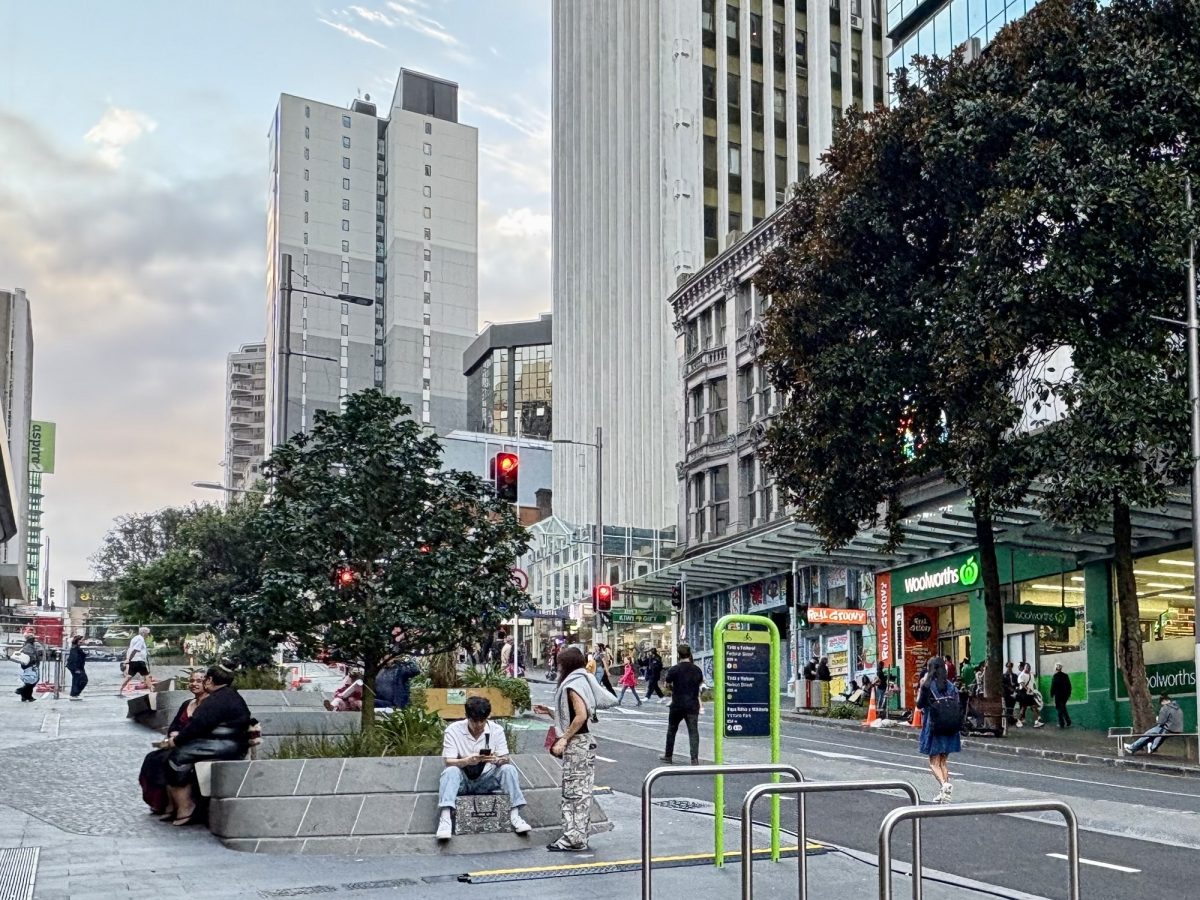
Revitalisation of Auckland’s City Centre

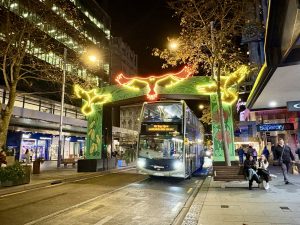
The revitalisation of Auckland’s City Centre will be hindered if Queen Street is once again flooded with private vehicles.
As reported by Greater Auckland, at the end of last year, Auckland Transport (AT) let slip a plan for a two-year “trial” of bringing back overnight traffic along Queen Street.
AT hasn’t followed  a transparent process in reaching a decision to go ahead with a trial and doesn’t appear to have considered the negative impacts.  As an advocate for Auckland here is what I wrote to the Mayor on 20 February (cc Local Board members, Councillors, City Centre Residents Group and AT Executives) asking him to stop the trial.
Dear Mayor Wayne,
Thank you for standing up for Auckland and for supporting the revitalisation of the City Centre.
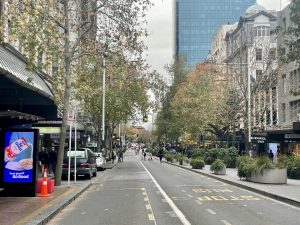
Have you noticed that it is now possible to be on Queen Street and hear birds chirping, the laughter of people and enjoy fresh air?  There are so many well-designed spaces and the street environment is greatly improved, making it an enjoyable experience to spend time (and money) in the City Centre.
This has happened as a result of the many projects and initiatives that are making the City Centre a more attractive place for people combined with the growing range of options to access the City Centre without a car.  Overwhelmingly, residents don’t own a car and the majority of visitors don’t arrive by private car.
If you dive into the stats you will find that there is less air pollution, less noise, public transport is more reliable, there are fewer crashes and more people are returning every day to discover that the City Centre is very different from the scare-mongering headlines.
Queen Street is a much nicer place for people to visit than it was before – with added greenery, more public art and much improved seating.  I have to admit that I was skeptical about the design of Waihorotiu shared path when it was first proposed but it is working really effectively for getting people around on wheels (especially young people who increasingly rely on e-scooters) and it means the footpath is safer for pedestrians.  This revitalisation and progress benefits all Aucklanders.
For the 40,000 residents who live in the City Centre the many improvements have literally been life changing.  There are now apartment buildings with approximately 1500 – 2000 residents on Queen Street and this continues to grow. We can even start to imagine a City Centre where families increasingly want to live and bring up children.
We can aspire to meet the Council’s target of growing the residential population to over 100,000 residents.   But this will only happen if you continue to back planning for the future (not the status quo) and hold firm to the core strategies like the City Centre Masterplan and Access4Everyone that are now reaping the rewards after many years of disruption.
Of course there is still more to do to improve accessibility, improve the perception of safety and provide care for the most vulnerable people who are on the streets as a last resort.  There is no doubt that the ongoing works around the CRL and Midtown have been really hard for businesses.  Fixes are needed around loading zones, and places for drop offs and pickups for Ubers and taxis. Improvements for mobility access to Midtown venues like the Civic are also needed.
However it makes absolutely no sense for AT executives to unilaterally address these issues with solutions that belong in the 20th century. 
This is not the time to backtrack on PT improvements (the planned 24/7 bus lanes on Wellesley Street) or to flood Queen Street with cars once again, especially just before the CRL’s new stations deliver a “people fountain” to Midtown.   AT’s proposed 2 year “trial” will result in more air pollution, more car noise, more traffic congestion and will make Queen Street (and access to Queen Street) less safe.  It will make the City Centre less attractive for people to visit other than in a car and will negatively impact residents.  It will also encourage drivers who just want to cruise Queen St  – the car engine noise that dominated Queen Street for many decades will return too.
Please demand that AT stop any plans to increase access for general vehicles at the expense of public transport and people. Please also insist on transparency and a process that involves all stakeholders including the Local Board and the City Centre Residents Group before there is any back-down by AT on planned improvements.
Let’s keep going with the revitalisation of the City Centre including working towards further pedestrianising Queen Street in time for the CRL opening.
Chair’s monthly report August 2018

This report covers the period 15 July until 14 August 2018.

Summary

Western Springs Development Plan consultation
A draft park development plan for Western Springs Te Wai Ōrea Lakeside Park has been released for public feedback.
The vision outlined in the draft plan for the park includes improved water quality in the lake and streams, connecting the surrounding areas via paths, and improvements to event infrastructure. The focus of the plan is on improving the existing state of a well-loved park without making major changes.
Consultation is open until 27 August.

Salisbury Reserve consultation

Land purchased to create an entrance way to Salisbury Reserve

12 Argyle Street, Herne Bay was purchased by the former Auckland City Council to improve the entrance to Salisbury Reserve. There are two draft options out for consultation. In both options the pathways into the reserve are improved with additional lawn and trees. The main difference between the options is whether or not to provide car parking on the reserve. We want to ensure the community can consider the best use of valuable green space. The old Masonic Hall on the site will be removed with as much of the building material recycled as possible. For a number of reasons (outlined in a post here) it wasn’t possible to retain the hall, but we have committed to improving the clubrooms that are in the reserve and making them more user friendly (the clubrooms are leased to the Herne Bay Petanque Club, but available to hire). There is $25,000 in the budget for the coming financial year to refurbish the bathrooms on top of other renewal work that has recently taken place.
Consultation on the two options has been extended until 30 August.

Teed Street upgrade celebration

On 18 July we celebrated the Teed Street upgrade with the Newmarket Business Association and local retailers. It was an opportunity to acknowledge everyone who had worked on the project and to bless the new art work commissioned for the upgrade by Ray Haydon. Our Auckland story and more photos here.

New art work in the City Centre

Light Weight O by artist Catherine Griffiths which is hanging between 1925 heritage buildings the Royal Exchange and Administrator House was opened on 1 August. Member Richard Northey gave a speech on behalf of the Local Board.
The work was commissioned as part of the O’Connell St laneway upgrade and was funded through the regional public art budget and city centre targeted rate.

LGNZ conference in Christchurch 15 – 17 July

I attended the annual LGNZ Conference in Christchurch 15 – 17 July as a National Councilmember and local board representative. For the conference I facilitated one of the workshops on Climate Change. I was also one of Auckland Council’s four delegates to the AGM held on 15 July. My conference report back will be tabled at the business meeting on 21 August.

Agrichemical-free parks

A number of parks within the Waitematā Local Board area are going agri-chemical free. The first parks to benefit will be Albert, Western and Myers, with the non-sports sections of Victoria Park also included.

More than $70,000 has been allocated to the initiative, which comes in response to public feedback during the Local Board Plan and Local Board Long-term Plan consultation processes. Our Auckland story with more details here

Waitematā funded or supported projects underway or completed

Parking updates
Thanks to the efforts of the Parnell Business Association and Parnell Community Committee Auckland Transport has agreed to fast track the implementation of the proposed changes. There are still a number of issues to resolve regarding how the current scheme is working for local residents.
In Grey Lynn Auckland Transport is planning on installing signage for the Residential parking zone by December with go live in February or March. However, concerns have been raised with me regarding AT’s proposal to introduce a time restricted parking zone that was not previously been consulted on.

On College Hill following consultation Auckland Transport will now proceed using a graduated rate structure which will charge $1/hour for the first 2 hours and $2/hour for subsequent hours. The rate structure will align with recent changes to on-street parking along Ponsonby Road and while it will have minimal impact on short-term parking utilised by customers and visitors, Auckland Transport expects that it will encourage parking availability.
Further details are on the Auckland Transport website.

New network bus changes
On 8 July Auckland Transport launched a new bus network for Auckland’s central suburbs. Most services have changed, including bus routes, route numbers, timetables and some bus stops. In the Waitematā area the changes appear to be working smoothly with a few exceptions. I have received complaints regarding the removal of services from Williamson Ave (this is also subject to a local petition), removal of a service to Herne Bay from downtown and the fact the Westmere service stops just short of the shops. Auckland Transport has advised that there will be review of the New network operations after 6 months.

Meetings and workshops: 15 July until 14 August 2018

  • LGNZ National Council meeting on 15 July
  • LGNZ AGM on 15 July
  • LGNZ Conference in Christchurch 15 – 17 July
  • Waitematā Local Board business meeting on 17 July
  • Catch up meeting with Local Board services team on 18 July
  • City Centre Advisory Board meeting on 18 July (as alternate to Deputy Chair Shale Chambers)
  • Board all day workshops on 24 and 31 July and 7 and 14 August
  • Chair’s weekly meeting with the local board services team on 23 and 30 July and 13 August (in our workshop on 23 July we received an update on accountability reports submitted from groups who had received community grants – Attachment 5)
  • Meeting to discuss achievements report on 23 July
  • Comms meetings on 23 July and 2 August
  • Transport portfolio catch up on 24 July
  • Wynyard Quarter Transport Management Association meeting on 24 July
  • Joint Governing Body / Local Board Chairs Meeting on 24 July
  • Meeting with members of the Consulate of the Republic of Korea in Auckland to discuss K-Pop Dance workshops during Mental Health Awareness week
  • Relationship manager monthly meeting on 26 July
  • Newmarket Business Association board meeting on 26 July (as alternate for member Rob Thomas)
  • Housing NZ bi-monthly meeting on 26 July
  • Meeting with representatives from Summerset Parnell development on 27 July
  • Meeting with participants of the Smart Seeds challenge
  • Parnell Plan working group meeting on 30 July
  • NZTA scene setting briefing for Councillors and Local Board chairs re Auckland’s light rail projects on 1 August
  • Meeting with representatives of the National Butterfly Centre project on 2 August
  • Local Board Resource Consent and Planning workshop on 6 August covering the resource consent and planning lead role covering:
     the Auckland Unitary Plan
     developing effective local board feedback for notified resource consents, plan changes and notices of requirement
     presenting feedback at a hearing
  • Auckland Cricket and Grafton Cricket Club introductory meeting on 7 August to discuss their strategic plans and upcoming events
  • Meeting with Auckland Transport to discuss options for traffic management improvements at Newton School
  • Parnell Business Association annual presentation to the local board on 9 August
  • Community Liaison Group meeting on 9 August for the Pt Chev/Meola Road cycleway project held at Pt Chev School.
  • Drop in session for the Facility Partnerships Policy Project consultation held at Ellen Melville Centre on 10 August
  • Local Board Chairs’ Forum on 13 August

Events and functions: 15 July until 14 August 2018

  • Teed Street upgrade celebration on 18 July
  • How We Win Change: A Bike Auckland presentation with Paul Steely White at Mason Bros building on 19 July
    How to be a Voice for Change: Towards Safer Streets for Auckland workshop with Paul Steely White hosted by Bike Auckland at Ellen Melville Centre on 21 July
  • InMotion Matariki all-wheels illuminated parade 2018 Hosted by Touch Compass Dance Trust on 21 July
  • Officiated at the Town Hall citizenship ceremony on 23 July
  • Attended the Campaign for Better Transport AGM with a presentation by AT CEO Shane Ellison
  • Attended the 2Walk and Cycle conference dinner on 31 July in Palmerston North for the Bike to the Future Awards at the invitation of NZTA (I was one of the judges for the awards)
  • Morning tea with Grey Lynn library staff on 2 August (photo bottom)
  • Auckland Conversations – Healthy Streets for Auckland presentation by Lucy Saunders and panel discussion at the Viaduct Events Centre on 2 August (photo right)
  • AT Cycling & Walking, Women in Urbanism and Boffa Miskell hosted presentation by Lucy Saunders at Boffa Miskell on 3 August
  • Opening night of HIR on 3 August at Herald Theatre at the invitation of Silo Theatre
  • Wynyard Quarter 7th birthday celebration on 4 August
  • Opening on 7 August of Moana, a large- scale mural painting by Ahota’e’iloa Toetu’u at the South British Insurance Company Limited Building (photo right of the artist and Paul Baragwanath who commissioned the art work)
  • Street Talks: Urban Japan: Lost in Translation? presentation hosted by the Chartered Institute of Logistics and Transport, ARUP and the Auckland Design Office at Auckland Central Library on 8 August
  • Presented on Local Board funding and advocacy to the Bike Auckland “Bike Burbs” hui held at Ellen Melville Centre on 11 August
  • Afternoon tea at the Grey Lynn Community Centre to celebrate the completion of the Re-purpose trial project by Grey Lynn 2030 and Earth Action Trust
  • Newmarket Business Association “State of the Nation” in Newmarket update at Event Cinema Broadway on 14 August followed by the movie “The Book Club” with ice cream and popcorn at the invitation of NBA.

Getting parking right for Auckland

This post was writtten for  Auckland Council’s Unitary Plan shapeauckland website.

How we regulate, control and plan for parking has a huge impact on Auckland’s urban design, the environment, housing affordability and our transport.

The subject provokes strong opinions and calls for free parking. Many decisions about parking have been based on myths, false assumptions and poor evidence. When defining issues in our city as “parking problems”, as “experts” we turn to more parking as the solution.

Regulations made with good intentions, have led to poor results, holding back our city’s potential.

We now have the opportunity, through the Unitary Plan, to put in place a best-practice approach to car parking that has the potential to unleash economic, social and environmental benefits.

UCLA economist Dr Donald Shoup (author of The High Cost of Free Parking) extensively studied parking as a key link between transportation and land use, with important consequences for cities, the economy and the environment. His thinking influenced Auckland Transport’s proposal for a city centre parking zone (implemented late 2012) with the aim of better managing on-street parking as a finite resource competing for other transport priorities. The scheme applies “demand-responsive pricing” and includes the removal of time restrictions, increased on-street parking prices and extended paid parking until 10pm.

It’s early days but all indications are pointing to success with greater availability of parking, a reduction in tickets and more casual visitors. The city also benefited from reduced maintenance costs with 62 per cent of parking poles removed. Other business centres are now looking at applying similar principles to free up on-street parking for customers.

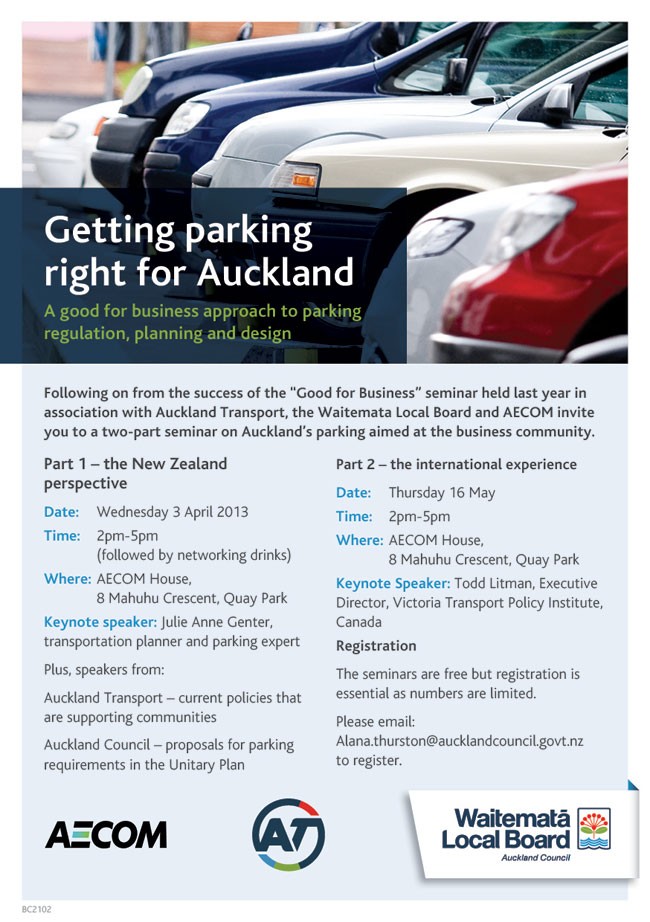
Parking seminarAt a Getting Parking Right for Auckland seminar in April [hosted by the Waitemata Local Board and AECOM] we heard that parking supply is not the problem, rather poorly managed oversupply. A total of 80 per cent of off-street parking is privately owned, which hinders its effective use. For example, minimum parking quantities in our current district plans means some car parks are only used during the day by commuters and shoppers while other car parks are used only at night for entertainment. Using land for empty car parks is hugely wasteful.

Traditional city requirements to include car parking with affordable housing have also been a major barrier to higher-density developments as a car park is not always required by inner-city residents.

Parking in the draft Unitary Plan

So how is the draft Unitary Plan shaping up when it comes to car parking requirements? The plan requires that car parking be managed to support:

  • intensification in and around the city centre, metropolitan, town and local centres and within mixed-use corridors
  • the safe and efficient operation of the transport network
  • the use of more sustainable transport options including public transport, cycling and walking
  • the economic activity of businesses
  • efficient use of land

It proposes that maximum quantities (with no minimums) apply in and around:

  • City centre fringe area
  • Centres zones: metropolitan, town, local
  • Mixed-use zone
  • Terrace housing and apartment buildings zone

Everywhere else minimum quantities apply with no maximums – except for offices (to discourage “out-of-centre” development motivated by the ability to provide parking).

The rationale is that in and around centres, maximums and no minimums supports intensification and public transport. Elsewhere the planners have explained that minimums are required as they are less willing to rely on the market to meet parking needs and are more concerned with the effects of “parking overspill”.

The removal of minimum quantities around town centres but retaining them for new developments appears to be a solution for today’s lack of public transport. But it creates a problem for future generations who will have to deal with the oversupply of parking and poor land use (plus the uneconomic bundling of car parking costs with housing).

The rationale for controlling the effect of parking overspill is poorly thought through. Instead we should allow the market to provide the right level of parking, allowing for overspill onto surrounding streets is a good use of otherwise empty road space. If that space reaches capacity – as has happened in our city fringe suburbs – the response should be to better manage the on street parking, for example, with a residents’ parking scheme.

When providing feedback on the draft Unitary Plan’s parking requirements, take the time to consider the evidence that emerges when parking is stripped back. Cities around the world are taking a different approach and being richly rewarded.