Conference report back: Velo-city Rio de Janiero 12-15 June 2018

This report was included in my monthly Chair’s report on the Waitemata Local Board July business meeting agenda.

Report back from  Velo-city conference: Access to Life

I was fortunate to attend and present at the annual Velo-city Summit 2018, a premier international conference on cycling and urban mobility.

Velo-city conferences bring together those involved in policy, promotion and the provision of cycling facilities and programs. Engineers, planners, architects, social marketers, academic researchers, environmentalists, business, and industry representatives join forces with government at all levels ranging from municipal politicians, policy makers and educators in knowledge sharing in order to build effective trans-national partnerships to deliver benefits worldwide.

 Velo-city 2018 Rio focused on the main theme Access to Life, linked to the overall goal of cycling inclusion. Building on topics of previous Velo-city conferences such as Health, Infrastructure, Technology, Governance and Data, Velo-city in Rio explored the fusion of these discourses through cycling inclusion.

I found Velo-city to be energising, informative and inspiring. I have previously attended Velo-city 2014 in Adelaide. At that time, it seemed as if Auckland had reached a tipping point, but still had a long way to go to catch up with cities that had embraced cycling as a legitimate mode of transport.  Four years later I was able to present the Auckland story (surprising many people with the progress that has been made) and found it encouraging to have it confirmed that Auckland is on the right path to a sustainable, smart city.

As highlighted at the conference the benefits for all of investing in cycling are overwhelming. Attending the conference reinforced for me that we’re now at a stage in Auckland where we know why we need to do it, we’ve heard from plenty of overseas experts how we need to do it, we have the funding confirmed, community support and the political will – we just have to get on with it!

My top take outs from the conference:

Access to life The bicycle can literally mean access to life for communities around the world. We heard from Mozambique where a bike can save 3 hours of walking to access water (photo right: Rui Mesquita, CEO of Mozambikes).  In Chicago a bike is a vehicle for community transformation and provides benefits such as reducing violence and the creation of jobs (opening plenary speaker: Oplatunji Oboi Reed from Equicity, Chicago). In Brazil bikes are empowering black women and creating the conditions for gender equality (Livia Suárez Founder of La Frida Bike Café, Preta vem de bike and Casa La Frida – photo right- and Jamila Santana, Artistic Coordinator of La Frida Bike ). Access to life can also be achieved for children by making cities child friendly “A city envisioned through the eyes of children is likely to be a bike city not one for cars” (Eliana Riggio, International Child Friendly Cities Secretariat at the UNICEF Innocenti Research Centre, in Florence)

It is so much more than just the bicycle The focus of debate that I often hear in Auckland is whether people personally want to cycle that is often framed misleadingly as an attack on those wishing to drive.  The conference reinforced for me that cycling is part of a far bigger response to the challenges of our time.  When a city provides its citizens with viable access to cycling as mobility it creates an environment for everyone that is healthier, more sustainable, less polluting and acts as a generator of happiness.

Just to give one example that was highlighted at the Global Policy panel discussion session.  The obesity crisis is a bigger problem world wide than malnutrition. To add healthy activity to daily lives walking and cycling must be must be a “hidden” physical activity.

A city for everyone   A common theme from speakers across the conference was the need to prioritise inclusion in transport planning so that the city works for everyone. Rubbish infrastructure such as poor-quality footpaths is a huge barrier.  For example Rafaella Basile from Cidade Ativa gave an overview of problems pedestrians face in Brazil – lack of infrastructure, insufficient width, surface quality or lack of maintenance. She stressed that insufficient pedestrian infrastructure harms the most vulnerable part of society.

Getting the infrastructure right can promote social inclusion, accessibility and equity.

In Auckland the barriers to children walking and cycling to school has been recently highlighted by the AA.  Their surveys found that Auckland parents and some schools actively discourage children from walking and cycling to school due to a lack of safety infrastructure.

Mixing up mobility The transport sector likes to refer to “intermodal” to describe getting around by difference conveyances.  It would be great to come up with a new term as I don’t think a session at the conference on “intermodality” really explains itself to most people (at least not in the Auckland context anyway). However, what it aims to achieve when mixed up with cycling is worth signing up for.   As Pascal Smet the Minister of mobility in Brussels highlighted it is about moving away from a city for cars to a city for people “We need to talk about objectives, not about the means” 

From a number of speakers we heard the many ways in which the integration of high quality public transport, transport orientated design, bike parking, bike share and quality cycle highways can increase the range of riders can travel and the number of people cycling.

The presentation on Brussels had some great before and after photos (eg the car park transformation above) very similar to projects we are working on in Auckland such as repurposing the Eastern Viaduct car park into a new plaza and removal of the Dominion Road flyover.

 Build it and they will come, but we’ve got to get on with it There were many technical experts at the conference particularly from the Dutch Cycling Embassy and the Danish Cycling Embassy.  They can boast impressive infrastructure resulting in a high proportion of people cycling for transport.  As is well known the key to achieving this is a network of high quality safe, separated cyclepath.

However the presenters took care to note that cities like Amsterdam and Copenhagen were not always great places to cycle.  They just got started a lot earlier to re-prioritise road space. Photo right: Mirjam Borsboom from the Dutch Cycling Embassy showing a “before” example.  The Netherlands started on the path to embracing cycling in the 70’s after the “Stop child murder” campaign.

Mirjam was also generous to say that the Dutch had things to learn from other places such as on her visit to Auckland with the Embassy last year.

The importance of a Vision Zero framework – starting with slower speeds

Road fatalities are the first cause of death for 5-9 years olds worldwide killing a total of 1.3 million people annually. In a presentation on Vision Zero we heard that Mexico City are adopting an approach of putting the safety of children first. (Clara Vadillo Quesada, from “Vision Zero for youth” in Mexico City) Clara presented examples of tactical urbanism using paint to improve the safety of school zones (quick, cheap, effective methods that we sometimes struggle to do in Auckland).

In Auckland and New Zealand we are on the verge of adopting Vision Zero to address our road safety crisis of increasing deaths and serious injuries (In the past three years, Auckland deaths and serious injuries have increased at almost triple the rate of the rest of NZ and around five times the growth of travel).  I was interested to hear more about Sweden’s ‘Moving beyond Vision Zero campaign that was launched in 2017. As presented by  Lars Strömgren, ECF Vice-President (photo right) Sweden, aims to encourage traffic planners and transport decision makers around the world to improve upon the 20-year-old campaign “Vision Zero” by factoring in the health benefits of active transport. A new goal should lead to traffic that saves lives and improves quality of life in addition to reducing traffic fatalities and injuries by promoting active mobility in the form of cycling and walking (ie not implementing vision zero to make safety improvements on roads that make it less attractive to walk and cycle)

 What was also emphasised by other speakers is that where there is no separated infrastructure the best safety tool is to reduce speeds to 30km on residential streets. Work is underway on Speed Management Plans for Auckland that will bring in long overdue speed reductions.

Cycling as “new” technology  The technology plenary session discussion at the conference was excellent for providing insight about what is happening right now at the front line and how cycling can be considered “new” technology.

Tim Papandreou, former Chief Innovation Officer with the City of San Francisco, Transportation Agency with experience working on Waymo (Google’s autonomous vehicle project) spoke to the sunsetting of traditional transport as technology changes (where don’t need drivers operating systems in the same way people have been removed from operating machinery) and how the bicycle fits into the platform of tech and a menu of transport choices.

Ninna Hedeager Olsen, Senior of Technical and Environmental Affairs at the City of Copenhagen (photo left) took a no nonsense approach to technology. Her city is adopting leading Intelligent Transport Solutions for mobility, especially some of the unique innovations for cyclists’ traffic management. “Technology should make lives better for people, not be a goal in itself, and although low-tech, the bike is very effective in Copenhagen”

Kevin Mayne, Development Director at ECF, stressed the importance of cycling advocates and policy makers engaging with the emerging policy challenges and not leaving it all to the automotive sector to dictate. He sees cycling as part of “new” tech with the opportunities coming from bike sharing and ebikes to play a role in Mobility as a service (MAAS).  However, the first question to ask is “where is the walking”?

I took away from the discussion the need for Auckland to identify the problem we are trying to solve and to create and dictate the space that technology is invited into.  As Tim cautioned “AV technology has no moral compass” so AV tech will just go where it is allowed to go.

Blast them with data Tim also took part in the interesting Big Data session with Philippe Crist, Strategic Advisor for Innovation and Foresight, International Transport Forum at the OECD facilitated by Kevin Mayne.

Philippe strongly emphasised the need to start with “Why do you need the data?” in order to make good decisions about what data is requested from companies. Cycling gets overlooked because not “big transport” and traditionally detected. An issue that AV tech looking to solve however he warned against accepting a solution of “tagging” riders (or walkers). He also provided a warning about the in built data bias because of the different economic profile of owners of Apple or Android smartphones which can distort analysis.  Cycling at all levels has to get into the Big Data space and engage, in order to create data that works for our needs. As Philippe said “Don’t wait to be invited into the room, we have to create our own room where the technology people talk to us”.

Tim also spoke of the need for a city to establish first “What data is wanted for” to avoid a power struggle for data particularly where there are privacy concerns. However, the good news is that data science is changing fast so there are ways of extracting data without revealing personal information.

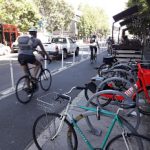
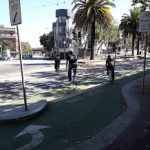
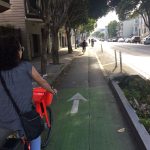
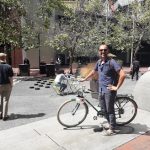
Tim provided some very practical and relevant advice about how best to use data to sell an idea. When advising decision makers, he starts with the story-telling rather than the data because we’re all emotional and that is what we respond to.  However, he puts this firmly in the context of the decision makers’ own agreed strategic framework backed up with data. Tim showed me the direct result of this approach on a tour of San Francisco at the end of my trip (see below). Safety inventions like kerb build outs are now going ahead without push back because San Francisco has adopted Vision Zero and they have the crash stats to identify dangerous intersections where intervention is required (eg photo right of a temporary safety measure).

Cashing in on the economic benefits:  We heard more on the overwhelming evidence that investment in cycling reaps economic benefits (eg Shopping by bike session).  Cycle tourism is more lucrative in Europe than the cruise ship industry (and less polluting).  650,000 jobs are as a result of the cycling industry (more than mining and quarrying).  From one study a 1 Euro investment has resulted in 35 Euros of benefit (Economic Benefits ECF research). I plan on following up with ATEED (Auckland’s economic development organisation) to find out what work they’re doing to promote cycle tourism.

In Vienna the largest shopping street has been transformed for walking and cycling. The opposition evaporated once opened due to the big lift in economic activity (photo right Robert Pressl, Project coordinator, CIVITAS).  ).  This was described as a “Lighthouse” project.  I think Karangahape enhancement project will come to be viewed in exactly the same way once finally completed.

Auckland’s story “I’ll just take the bike”

I presented as part of a session Cities for people? Rethinking Urban Planning  together with Mirjam Borshboom from the Dutch Cycling Embassy and Firoza Suresh from the Smart Commute Foundation, India . The session explored the necessity to refocus our planning away from a planning model based on individual motorized transport towards people-centre low-carbon sustainable mobility systems.

My presentation outlined how in Auckland we’re making the thought “I’ll just take the bike” a reality for Aucklanders and considered how far we are actually rethinking our urban planning.

A number of people approached me after the presentation to say how surprised and impressed they were to see the progress made in Auckland. I was proud to represent Auckland at the conference.

Summing up the conference

The conference was spread over four days with too many presentations to  attempt to sum up (check out the ECF website for the full write up about the conference). In addition to the key themes I found it really inspiring to hear from people working in really challenging places to bring about better conditions for people to ride bikes. For example Nikita Lalwani, the Bicycle Mayor of Baroda in Gujarat, India (appointed in May 2017 by BYCS, a Dutch NGO) who promotes cycling in a city with huge congestion but no cycle facilities. She does it because commuting by bike is still healthier and more convenient for her.

I enjoyed hearing about the compost business powered by a cargo bike and creating jobs (photo right). This is exactly what we need to be looking at in Auckland. The conference was an amazing opportunity to meet people from around the world doing really interesting things to create the conditions to encourage cycling such as Sile Ginnane from Liberty Bell in Dublin using a citizen-led low cost auditing system to gather qualitative data about the cycling and walking environment.

The conference was not without its controversies.   Participants from developing countries received a discounted registration that was still well beyond the means of average Brazillians.  The sessions were by a diverse range of speakers that wasn’t reflected in the make up of participants.

The cycling parade is a highlight of every Velo-city (photo right) but it wasn’t so great for the locals who had to put up with central streets being shut down for our convenience and enjoyment.

From a visitor perspective it was amazing to experience Rio and the spectacular waterfront ride.   On my trip I also enjoyed waterfront rides in Montevideo, Palma, Seattle and San Francisco.  It highlighted the huge potential to transform Auckland’s waterfront along Tamaki Drive into an even better mecca for tourists and locals.

I’m grateful for the opportunity to attend the conference (made possible by the generous airfare gift from a friend) and to have met so many amazing people.  I was able to explore new ideas and come home equipped with the questions to ask to ensure we deliver best practice.

Joke told by one of the speakers:  How do you recognize a cycle path in Germany?  There is a car parked in it.

(sound familiar Auckland?  Photo credit: Bike Auckland)

Presentation summaries

There are excellent write- ups of many of the speakers on the European Cycling Federation website.  I acknowledgement the assistance of referring to these summaries in writing up my report.

Attendance costs

  • Conference registration $NZ870.00 – covered by Auckland Transport (the abstract for my presentation was originally submitted by Auckland Transport)
  • Accommodation (3 of 5 nights) $NZ432 – covered by Auckland Council
  • Airfare – a birthday gift from a friend
  • All other expenses – transfers, accommodation (2 nights), meals etc – personal cost

Velocity Conference Side Event: The Big Picture: A Safe System for Cycling in Cities

At Velo-city I met Anna Bray Sharpin, a Kiwi based in Washington DC who works for World Resources Institute. She invited me to present my Auckland case study at a conference side event. Participants were from 12 developing countries with the potential to incorporate cycling as part of transport solutions.

Melinda Hanson from NACTO (National Association of Transportation Officials) gave an excellent presentation on Strategies for Scaling up Cycling.  Her 10 points summarizing the politics of “How” are really relevant to Auckland right now.

1. Show it works

2. Measure & promote

  • Bike counts
  • Economic benefits – speak to what politicians need to hear
  • Use new technology to track metrics eg origins and destinations

3.Reach out – move away from images of people on bikes wearing helmets to humanize cyclists

4.Support allies – eg bike advocates

5. Emphasise safety with a focus on speed reduction

6. Make cycling mainstream

7. Leverage the private sector – eg dockless bike share

8.Think about cycling as a big infrastructure project. Will be more eligible for multi funding

9. Be bold (Auckland’s Te ara I whiti/Lightpath was used as the example in Melinda’s presentation – photo above)

10. Don’t back down – example of Seville (StreetFilms: How Sevilla got its cycle network) that demonstrates the importance of a  bold vision (18km network built within 18 months for 32m Euros to achieve 8% mode share). Know there will be push back but trust the process and the outcome.

Checking it out up close – cycling tour of San Francisco

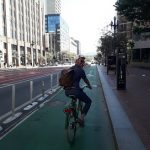
On route back from my trip I stopped off in San Francisco and was treated by Tim Papandreau  to a tour of cycling infrastructure that is transforming the city and significantly increasing cycling numbers.
 

Chair’s monthly report June 2018

This month I have prepared a brief update to be reported at the June meeting when Deputy Chair Shale Chambers will be acting. I am out of New Zealand 2 June – 15 July (including attendance at the Velo-city conference in Rio de Janiero)

Highlights

10 year budget

All Local Boards had an opportunity to present to the Finance & Performance Committee on their 10-year budget priorities.

I presented on behalf of Waitematā Local Board together with Deputy Chair Shale Chambers and member Adriana Christie (photo right).

The Board’s presentation is attached (Attachment 1).  We focused on seeking Governing Body support for the Board’s priority unfunded project – the development of 254 Ponsonby Road.

Local Government New Zealand

I have recently been appointed to the National Council of LGNZ representing Local Boards.  This position has been created in anticipation of a constitutional review of LGNZ’s rules to look at the representation of local boards and other sector groups.

My first official engagement in this role was to attend the 24th Central and Local Government Forum held at Premier House on 10 May (photo below).  Local government representatives were impressed with constructive level of engagement from the 14 Ministers who attended the forum.

The forum resulted in many positive discussions focused on the key areas of Water, Climate Change, Regional Development and Housing.

I also attended my first National Council meeting on 17 May and the Governance and Strategy Advisory Group meeting on 28 May.

Transport:

Tamaki Drive Cycleway

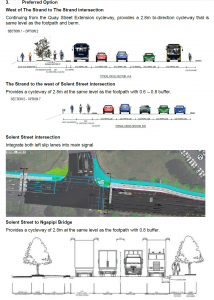
Local Board perseverance and advocacy pays off!  Auckland Transport has been working on the design of the Tamaki Drive cycleway between the Strand and Ngapipi intersection.  The board is very supportive of this project that will connect to the bi-directional Quay St cycleway however we have repeatedly raised concerns about Auckland Transport’s original proposal to maintain a small section of shared path between the Strand intersection and Solent St. We considered this to be an unacceptable safety risk for the increasing numbers walking and cycling this route.

We requested a continuous cycleway experience for the entire route (separating people on bikes with walkers) and the removal of the Solent St slip lanes to provide one controlled crossing rather than three. After the board rejected a number of design options Auckland Transport has finally agreed to progress a best practice design that delivers a high quality, safe and attractive cycling facility.  Construction is proposed to start in December 2018.

Road Safety

 As previously reported, Auckland is facing a road safety crisis with devastating consequences.  Auckland Transport board recently released a report called Auckland Transport: Road Safety Business Improvement Review, that concludes. “Road safety performance in Auckland in recent years … reflects a number of deficiencies of public policy at central government and local level. Most of all it reflects an absence of commitment to improving safety on New Zealand and Auckland’s roads.”

The Local Board has consistently advocated for Auckland Transport, NZTA and NZ Police to prioritise safety.

In some good news, Auckland Transport is proposing to install pedestrian crossings on Hobson St and College Hill (consultation ended on 14 June).

Regional Land Transport Plan

I prepared the Board’s submission to the draft Regional Land Transport Plan consulted on between 1 -14 May.

In summary the Waitematā Local Board supports the overall direction of the RLTP. It shows strong alignment between central government and Auckland Council and a real commitment to deliver a transport programme that responds to Auckland’s challenges.  It is reassuring that much of the draft RLTP reflects the transport objectives and initiatives set out in the Waitematā Local Board Plan.

We support the strategic approach towards creating an accessible, connected, safe and sustainable transport network. The RLTP aligns with the Local Board outcome: An accessible, connected and safe transport network with well-designed streets (Waitematā Local Board Plan 2017).

The Local Board supports the Regional Fuel Tax (RFT).  Seventy-two percent of Waitematā submitters to the 10-year Budget support the RFT and want investment to be focused on public transport and active transport.  We particularly support the focus in the RLTP on:

  • Safety, with a Vision Zero approach
  • Environment
  • Rapid transit
  • Accessibility
  • Placemaking
  • City centre
  • Active modes and pedestrian prioritisation

In addition to the projects identified below for inclusion in the transport programme, we request as a priority additional funding be identified to deliver the 10-year Programme Business case for cycling recently adopted by Auckland Transport.

The full submission is included as a report to the board’s June business meeting agenda.

During the consultation period I attended the Have your say session at the Grey Lynn Library Hall on 12 May with members Richard Northey and Denise Roche.

Further transport matters are reported on as part of Auckland Transport monthly report.

Parnell Plan

 Last month the board signed off on the draft Parnell Plan consultation document. “Towards a 30-year plan for Auckland’s First Suburb”  is now out for consultation until 29 June.

Details at https://www.aucklandcouncil.govt.nz/have-your-say/topics-you-can-have-your-say-on/parnell-plan/Pages/default.aspx

Our upcoming engagement sessions include:

  • 10am- 2pm, 6 and 16 June: Drop-in session at the Parnell Library
  • 9am-12pm, 9 and 23 June: Parnell Farmers Market
  • 5pm-9pm, 21 June: Winter Solstice event at 69 St Georges Bay Road

Auckland Domain Committee

The Committee met on 30 May (I am deputy chair of the committee). We approved a new natural play space and the Kari Street Commons informal recreational space.     The committee is grappling with the issue of commuter parking in the Domain that is diminishing the experience of Domain visitors and creating safety issues for pedestrians.  A report on a proposed way forward to improve access is coming to the next Domain committee meeting in August.

Community grants

At the Board’s May meeting we granted $125,000 in accommodation grants and more than $49,000 in community grants.

The board’s next Quick Response grants round opens on 5 June and closes 6 July. Details are on the Council website.

Events

Waitematā is a year-round busy place for an impressive range of events. Recently I have enjoyed attending:

  • Ockham Book Awards
  • 2018 Writers Festival opening – Gala night
  • Mt Albert Town Centre upgrade opening (in Albert-Eden)
  • GridAKL Tech & Innovation – Building a better world. The Funding Network Tech week event
  • Opening of the Art Fair at the Cloud
  • Opening of the Doc Edge Film Festival at Q Theatre
  • Bike Bike Debate at MOTAT on 31 May

On 25 May I attended the Ngāti Whātua Ōrākei commemoration event to l mark the 40th anniversary of the stand at Bastion Point.  After 506 days of occupation, protesters faced off with members of the police, armed forces and the government over plans to build luxury housing on Ngāti Whātua ancestral land at Takaparawhau – Bastion Point, resulting in 222 arrests. The stand at Bastion Point led to the first successful retrospective claim hearing at the Waitangi Tribunal.

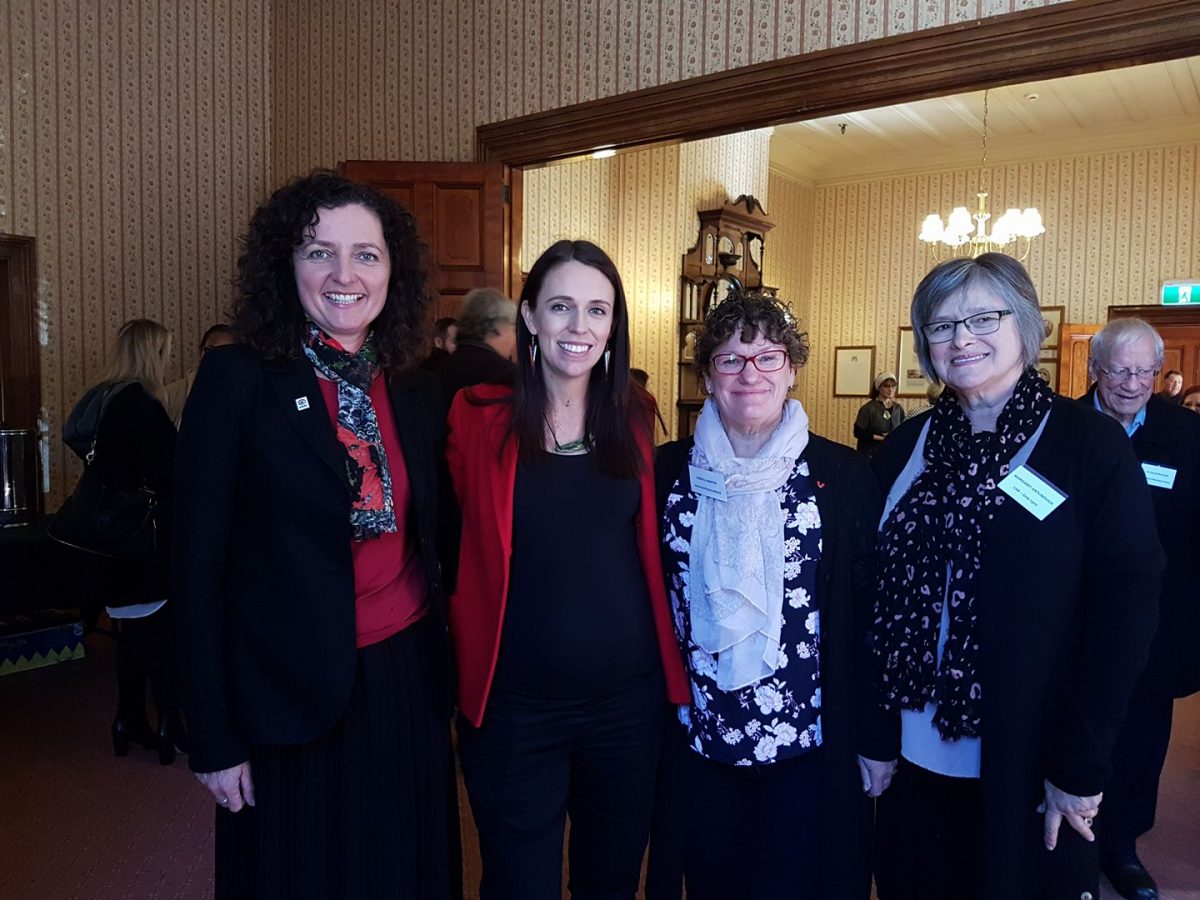
The Prime Minster held a morning tea event on 31 May for members of the Mt Albert electorate community.

Mt Albert Electorate community morning tea with the PM Jacinda Ardern

Chair’s Monthly Report May 2018

This report covers the period 11 April – 8 May 2018.  

 Highlights

10-year budget and Local Board priorities

The Waitematā Local Board received almost 1500 submissions on the Council’s 10-year budget and Local Board priorities. I enjoyed reading them all to understand concerns and what we need to improve on. It was also hugely encouraging to receive such positive feedback confirming we are heading in the right direction.

A summary of the feedback received was presented at a board business meeting on 3 May.  

Highlights include:

  • 72% support the regional fuel tax wanting the additional funding to be directed at improving public transport and walking & cycling
  • 81% support the proposed water quality targeted rate (to stop sewage going into the harbour)
  • 69% support natural environment targeted rate
  • 63% support the proposed rates increase of 2.5%
  • 83% support or partially support the local board’s priorities

Other themes

  • Support for additional Auckland Art Gallery funding of $20m
  • Support for Victoria Quarter city centre improvements
  • Support for Vision Zero to be included in the Auckland Plan 2050
  • Strong support for continuing to develop the Auckland cycling network with separated cycleways
  • Support for increased support to tackle rough sleeping and homelessness.

The Board’s feedback on the 10-year budget 2018-2028 and the draft Auckland Plan 2050 is available on the minutes to the 3 May meeting. We also approved our advocacy initiatives that will form an appendix to the Local Board Agreement 2018/2019.

Auckland Waste Management and Minimisation Plan

The draft waste plan was consulted on at the same time as the 10-year budget. We received 130 submissions from the board area.  There was a strong level of support for the overall direction of the draft plan and the proposals consulted on.

The board’s feedback (Attachment 1) was presented at the Waste Management and Minimisation Plan hearing on 3 May by the Natural Environment portfolio holders Denise Roche and Rob Thomas.

 Regional Land Transport Plan feedback

 The Regional Land Transport Plan (RLTP) lays out the vision for Auckland’s transport infrastructure over the next ten years- an accessible, safe and sustainable city and region.  The goal of the RLTP is to ensure that Auckland can address its current challenges and take advantage of future growth. The RLTP focuses on:

  • reducing congestion
  • improving freight reliability
  • road safety
  • promoting walking and cycling
  • advancing public transport.

The Board’s presentation to Regional Transport Committee hearing on the RLTP is attached (Attachment 2). The board’s submission will be finalised by 17 May.

Homelessness

We know from the feedback we regularly receive and through the 10-year Budget consultation that our residents would really like to see homelessness and rough sleeping tackled so we no longer have vulnerable people sleeping out on our streets.  The board has agreed to the following advocacy positions to be included in our Local Board Agreement 18/19.  At the same time we welcome the government’s announcement that $100m is to be invested in homelessness including an increase in the number of places available through Housing First, a solution that has been shown to work.

Housing solution for homeless people

Deliver short and medium-term housing solutions to address homelessness

  •  The Governing Body to partner with the Waitematā Local Board to enhance provision of city centre public facilities such as toilets, showers and lockers
  • The Governing Body to financially support the development of Mission HomeGround
  • The Governing Body to increase funding to support Housing First Auckland

Storm Damage

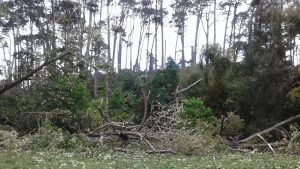
Auckland was hit by a severe storm on the evening of 10 April that caused wide spread power outages and the toppling of trees all over Auckland.  At Western Springs a number of large trees came down causing paths to be closed (the track through the Western Springs pine stand will remain closed while 30 pine trees are assessed that are at risk of toppling).   Our Auckland story on track closures: Attachment 3

Tree debris is being collected by Auckland Council’s contractor Ventia from the side of the road. There is currently a backlog that I have been advised should be cleared by the week beginning 14 May.

Auckland’s Road Safety Crisis

As reported on last month I attended the Road Safety Summit in Wellington called by the Associate Minister of Transport.

Tragically in the past three years, Auckland’s deaths and serious injuries (DSI) have increased at almost triple the rate of the rest of NZ and around five times the growth of travel. Of 29 world cities, Auckland has the second highest pedestrian fatality rate (Our Auckland story: Attachment 4).

Red light running is particularly an issue in the city centre. This has been highlighted at the intersection of Nelson Street and Union St on the Freemans Bay School walking route that has been subject of recent complaints (a video posted on social media showed seven drivers red light running in just one light phase). I have been following this up with AT and NZ Police who are yet to confirm what action is going to be taken.

I reported on road safety issues in the latest Ponsonby News update and the completion of the Ponsonby Pedestrian Improvement project (Attachment 5)

Monkey Bars are back in Grey Lynn Park

 The playground upgrade at Grey Lynn Park completed in November 2016 removed monkey bars from the design.  Following a petition from twins Ila and Jaya Patel (photo right) the Board agreed to fund new monkey bars.  The new equipment has now been installed (Our Auckland story: Attachment 6).

Meetings and workshops: 11 April until 8 May 2018

  • Weekly chair’s meeting held every Monday with the local board services team
  • Government Policy Statement on Land Transport – briefing session with transport strategy team on 12 April to discuss local board feedback
  • Catch up with Maggie Gresson, of Artists Alliance and board member Richard Northey
  • Meeting with Ian Clark (Director at Flow Transportation Specialists Ltd) on 12 April regarding Western Springs Precinct parking project
  • Breakfast meeting with Mark Ames from Strategic Cities hosted by Auckland Transport
  • Catch up with Jill Keyser from Splice on 13 April
  • April cluster workshop for local board members on 16 April
  • Waitematā Local Board business meeting on 17 April
  • Meeting on 18 April to discuss local board advocacy items
  • Ports of Auckland presentation for board members on 19 April draft 30 year masterplan
  • Board all day workshops on 24 April, 1 May and 8 May
  • Inner city network meeting at Auckland Central Library on 26 April
  • Meeting to discuss representation review
  • Monthly comms meeting on 26 April
  • Regional Land Transport Plan briefing by Auckland Transport for local board members on 30 April
  • Finance and Performance committee workshop on 2 May: 10 year budget update
  • RLTP hearing on 7 May (Attachment 2)
  • Ponsonby Business Association board monthly meeting on 8 May

Events and functions:  11 April until 8 May 2018

  • Regional Facilities Auckland tour of the Civic Theatre and function for local board members and advisory panel members on 11 April (photo right)
  • How London became a cycling city presentation by Mark Ames from Strategic Cities hosted by Russell McVeagh
  • Launch on 13 April at the Cloud of a trial of two city centre e-buses by the Mayor and Associate Minister for Transport Julie-Anne Genter (photo below right)
  • Popped into the  Waitemata Safe Routes drop in session at the Grey Lynn Community Centre on 14 April led by Boffa Miskell who have been engaged by Auckland Transport to lead a technical review of the Waitemata Safe Routes programme
  • Pump tracks are for girls too!” event with Sarah Walker organised by Women in Urbanism at the Grey Lynn pump track on 14 April
  • Eco Day Festival at EcoMatters on 15 April
  • Opening of Body Worlds Vital at the Hilton Hotel on 23 April
  • The opening night of Southern Star – Te Tonga Whetu o te Rangi on 24 April including live musical performances choreographed to architectural-scale, light artworks by Jeff Smith and Johann Nortje projected onto the historic brick and stone walls of St David’s. (My speech: Attachment 7)
  • Anzac day dawn service at the Auckland War Memorial Museum
  • Spoke on behalf of the board at the Grey Lynn RSC Anzac day service (My speech: Attachment 8). Photo below presenting the local board wreath with board member Denise Roche
  • Comedy Gala opening night on 26 April at the invitation of ATEED
  • Re-opening of the Richmond Road Medical Centre on 27 April by PM Jacinda Adern
  • Trash to Trade competition organised by Grey Lynn Waste Away at the Grey Lynn RSC on 29 April (photo below)
  • Mrs Warren’s profession opening night at the ASB Waterfront Theatre at the invitation of Auckland Theatre Company
  • Unveiling of Te Toka o Apihai Te Kawau by Ngāti Whātua Ōrākei and Ports of Auckland on 4 May (photo right)
  • Foundation North lunch on 4 May to launch their Strategic Plan with the PM and Mayor Goff
  • Attended the Fossil Free Acceleration Tour with Bill McKibben and 350 Aotearoa at the Auckland Town Hall on 7 May
  • Feijoa Festival at Tabac, Mills Lane on 8 May

Photo right: Trash to Trade competition.  Grey Lynn 2030 trustee Brigette Stigid with board member Denise Roche who spoke at the event and board member Adriana Avendaño Christie who was one of the judges, alongside Metal as Anything Creations‘ Andrew Palace. The established artisans category was won by Jared Diprose from Goose Boards the new designer category by Fiona Bonner from Floroganza, and the young makers category by Briar Shaw-Smith.


Anzac day speech 2018

Grey Lynn Parade and Service

Tēnā koutou e ngā rau Rangatira mā e huihui mai nei

E ngā hau e whā

Tēnā koutou, tēnā koutou katoa

Greetings to everyone gathered here this morning.

It is a great honour to be invited to speak today on behalf of the Waitematā Local Board. I’m joined by newly elected board member Denise Roche.

Laying the wreath on behalf of the local board with board member Denise Roche

We all come together this year on the 103rd Anzac day in the final year of the 100th commemoration of the First World War.

I give thanks to the Grey Lynn RSC for bringing us all together as a community to remember the lives lost and the huge impact of war on those who served and their families. I acknowledge the passing of president Rocky and sadly the many other life members who have passed in the last year.  Thank you to the club committee and new generation of members keeping the club going strong as a welcoming, inclusive place. The Local Board is pleased to be able to support your very special and unique Anzac day parade and service.

We have all come together, not to glorify war, but to commemorate New Zealanders, Australians and Pacific peoples who served and died in all wars, conflicts and peacekeeping operations and share the sorrow at the loss and suffering of so many lives in war including those opposing war.

Of 74,000 New Zealanders who served in World War 1 on the Western Front between August 1914 and November 1918,  nearly 14,000 lost their lives. Those who volunteered for the war effort on behalf for the British Empire included approximately 1000 men from the Pacific Islands, including 500 from the Cook Islands and 150 from Niue.

In April 1918 war raged. Heavy causalities continued until armistice day in November. It is this year that we move from commemorating war towards peace. We look to the journey home, to loved ones keeping the home fires burning, and the difficult time recovering from the terrible effects of war.

I give thanks for the ANZAC spirit of sacrifice, courage, commitment and giving which has seen NZ cope through natural disasters and rise to the challenges of our time. I tautoko the Prime Minister’s call, at a time when risks to global peace and security are growing and the rules-based system is under such pressure, that we must recommit ourselves to the cause of non-proliferation and disarmament, and to the norms and rules which support those endeavours.

We remember and reflect on ANZAC day together and work to ensure future generations do not face the horror of war. As we remember those who sacrificed their lives and honour those who served we recommit to the importance of peace, independence, fairness and freedom.

Kei wareware tātou

Lest We Forget

Kia ora huihui tātou katoa


Chair’s monthly report April 2018

This report covers the period 14 March until 10 April 2018.

 Highlights

Newly elected board member Denise Roche was sworn in at the board’s business meeting on 20 March. (photo left)


Consultation on the 10 year budget

Have your say month wrapped up on 28 March.  The Board hosted 2 public meetings, a hearings style meeting where 19 groups and individuals presented and four drop-in session at our libraries (photo right: Parnell Have your say public meeting attended by board members and councillors Penny Hulse and Christine Fletcher).  Spray free parks is one of the priority issues that was consulted on by the Board (Attachment 1)

A summary of the consultation feedback will be available in May.

New public space at the Viaduct

In October 2017 I reported that Panuku had made the decision to close the Eastern Viaduct car park to create a new public space in line with the Waterfront Plan. This followed advocacy from the local board and councillors Richard Hills and Chris Darby.

Following the space being used increasingly for temporary events it has now been permanently closed.  I attended the karakia on 26 March led by Ngāti Whātua Ōrākei to acknowledge the closing of the Eastern Viaduct as a car park and the commencement of the construction and installation process of a public space.

Over the Easter break I enjoyed having lunch with a friend at the new communal table (photo above).   See Attachment 2 for more details.

Homelessness

Chronic levels of homelessness in the city centre is a major concern. The board wishes to support solutions and is looking to provide appropriate public facilities (one of the priorities we highlighted in the recent 10 year budget consultation).

I attended the Heart of the City organised “ending homelessness” event on 20 March at the Ellen Melville Centre to hear the latest update from Moira Lawler, CEO of Lifewise,  and Chris Farrelly, the Auckland City Missioner on how they are working to end homelessness in central Auckland.

They talked about the collaborative approach underway, including Housing First and the redevelopment of James Liston Hostel and the recently announced Mission Homeground (incorporating accommodation and wrap round services) to be developed on the Mission’s Hobson St site.

 Western Springs Native bush restoration project

Residents were recently provided with an update (Attachment 3) on the Western Springs Native bush restoration project.  Attachment 4 the Our Auckland story on the project.  In addition, Deputy Chair Shale Chambers spokesperson for the project has provided this update on 10 April via Facebook in response to concerns about the process.

The elected members of the board do not, nor have they in the past, had any direct involvement in the selective cutting of the pine trees. This has been a decision of arborists and Council parks staff who are making health and safety decisions to keep the track and park area open, and keep property and lives safe. No assurance can be given that those decisions, where necessary will not be made in the future (for example, as a result of today’s winds) but this will only be done for genuine health and safety reasons, not any early implementation of the plans. That is in line with the local board’s advice that the trees are failing at an increased rate. The restoration project is shortly to go to a notified public hearing process. Those who wish to question the reports and advice that the local board has relied on in making its decision, in its view in the public interest, to proceed with the restoration project and the removal of the remaining 200 pines will have their opportunity there to have their say. The board will be bound by the outcome. The ‘consultation’ is therefore a publicly notified resource consent hearings process available to all interested in the outcome of the plans. We invite and welcome that involvement. Council advice can be tested there. If it is correct and the project is granted consent, the first stage pine removal phase of the project will proceed. Locals and interested parties will then be involved by way of consultation on in the detail post-pines future of the area and the park restoration project, as promised.

Victoria Quarter Petition

 At the Board’s March business meeting we received a petition presented by Emily Reeves, city centre resident, calling for safer pedestrian access in Victoria Quarter. (Attachment 5)

We passed a resolution requesting staff to refer the petition to the Development Programme Office for consideration in the allocation of the targeted rates projects in the Victoria Quarter and Auckland Transport for consideration for improvements in the road corridor.

Work is already underway by Auckland Transport on significant safety treatments in the Cook St off ramp area of Victoria Quarter.  The proposals will go out for consultation shortly.

 Great North Road – car transporters

I’ve previously reported on the issue of car transporters illegally unloading on Great North Road. This high risk activity continues despite AT regularly issuing fines (this is just considered a cost of doing business).

I’ve met with AT’s manager of parking who is calling a meeting of operators and NZTA to discuss the options available for increasing the number of loading zones and for businesses to undertake more activities within their premises. If car transporter operators continue to unload illegally NZTA has the power to revoke operator licences.

Quay Street cycleway extension greening

The board has asked Auckland Transport to look at options for further greening Quay St as part of the cycleway design.

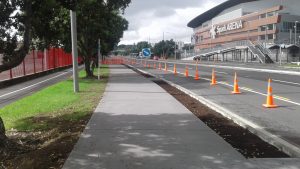
At our March meeting we requested Auckland Transport to develop a rough order of cost for including a green bus shelter roof as part of the Quay Street project to be funded from the Local Board Transport Capital Fund (photo above right: cycleway under construction showing inclusion of a strip in the design for planting)

Events

March was a big month for events in Waitematā.  Pop, the Board funded annual series of interactive art projects is now a fixture of the Auckland International Arts Festival (photo right pop marbles in Freyberg Place).

At Pasifika the mayoral and government’s entourages joined forces for the first time to visit stages in nine of the villages. (Photo below: At the Tuvalu village with Fala Haulangi)

Meetings and workshops: 14 March until 10 April 2018

  • Weekly chair’s meeting held every Monday with the local board services team
  • Site visit on 14 March to berm on Beresford Street where poisoning has taken place (photo right)
  • Meeting with the Newton Residents Association representatives on 14 March
  • Fortnightly meeting with comms adviser on 14 and 29 March
  • Dropped by the Auckland Transport Karangahape Road parking plan consultation open days on 14 and 16 March
  • Meeting with Parnell Business Association representatives on 15 March
  • Have your say Grey Lynn Library drop in session on 15 March
  • Have your say Parnell public meeting hosted in partnership with Parnell Community Committee on 15 March
  • Have your say Leys Institute Library drop in session on 16 March
  • Surrey Cres/Garnet Road Community Liaison Group meeting hosted by Auckland Transport on 19 March
  • Have your say cuppa with Splice at Ellen Melville Centre attended by inner city resents particularly new migrants (supported by Auckland Council translator).
  • Waitematā Local Board business meeting on 20 March
  • Auckland Transport’s quarterly briefing for Local Boards on 21 March
  • Drop in session on 21 March for elected representatives at Albert St re: Sale and supply of Alcohol Renewal of Licences Amendment Bill (No2)
  • Participated in Auckland Transport’s consultations sprint at Customer Central (exploring AT’s end to end consultations process from the customer lens)  with a face to face interview on 21 March
  • Local Economic Development Masterclass; Supporting economic resilience hosted by ATEED at GridAKL on 22 March
  • Have your say Waitematā Local Board hearing on 22 March.  The Board received 19 presentations from a range of groups and individuals
  • Briefing from Housing NZ representatives on 23 March re the redevelopment plans for 139 Greys Ave
  • Hui on 23 March between Local Board Chairs and the Chair of the Tūpuna Maunga Authority and to discuss some activities planned for 2018 by the Tūpuna Maunga Authority.
  • Have your say Central Library drop in session on 23 March
  • Have your say Parnell Library drop in session on 26 March (photo right)
  • Parnell Plan working group meeting on 26 March
  • Board all day workshops on 27 March, 3 and 10 April
  • Catch up with KBA general manager on 28 March
  • Wynyard Quarter Transport Association board meeting on 28 March
  • Joint governing body and local board chairs workshop on 28 March
  • Relationship Manager catchup on 29 March
  • Monthly transport portfolio catch up on 4 April
  • Meeting with Manager, AT parking on 4 April
  • Meeting on 5 April with representatives of the Parnell Business Association to discuss Paws in Parnell event debrief
  • Catch up with CEO, MOTAT on 6 April
  • Meeting on 6 April with KBA and NZPC to discuss public facilities on Karangahape Road
  • Ponsonby Business Association committee meeting held on 10 April

Events and functions:  14 March until 10 April 2018

  • Grey Lynn 2030 AGM and Green Screen showing of Living Dangerously on 19 March
  • Ending Homelessness in Auckland’s city centre organised by Heart of the City at Ellen Melville Centre on 20 March
  • Far Side of the Moon at the Aotea Centre on 22 March at the invitation of the Auckland Arts Festival
  • Pasifika Festival walkabout with the Prime Minister and the Mayor
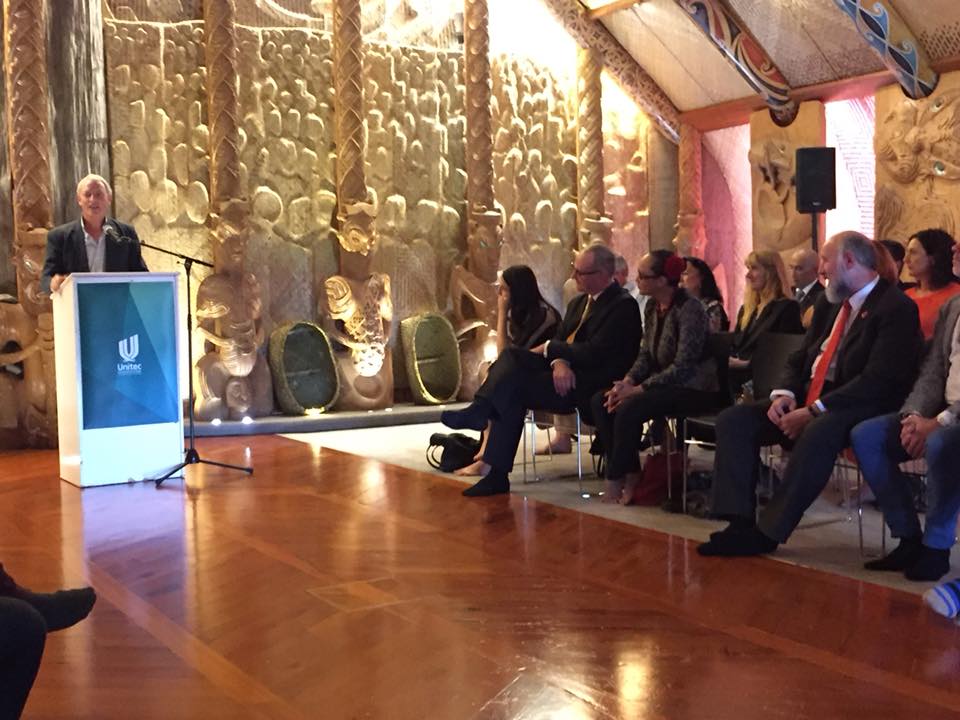
  • Government’s Unitec Housing announcement at Te Noho Kotahitanga Marae on 25 March (photo right)
  • Karakia on 26 March led by Ngāti Whātua Ōrākei to acknowledge the closing of the Eastern Viaduct as a car park and the commencement of the construction and installation process of a public space.
  • YMCA – Ride and Refresh Launch Event on 27 March (new service providing showers and secure parking for bike commuters) Photo right
  • Women in Urbanism discussion with NZTA on 28 March
  • Part of the official party for the Citizenship Ceremony in the Town Hall on 3 April
  • Associate Minister Transport Julie Anne Genter opens the Road Safety Summit

    Bike Breakfast on 5 April at Bestie café sponsored by KBA

  • Opening of the Uptown Business Association movie night in Basque Park on 7 April
  • Jam on Toast at the Grey Lynn Community Centre on 8 April
  • Opening of the Auckland International Cultural Festival at Mt Roskill War Memorial Park on 8 April
  • Attended the Road Safety Summit in Wellington on 9 April and gave a presentation on Auckland’s road safety crisis as part of a panel discussion on Local Government’s view about what more can be done to improve road safety (Attachment 6).

Road safety crisis facing Auckland

Associate Minister Transport Julie Anne Genter opens the Road Safety Summit

Local Government Road Safety Summit 9 April 2018

Panel discussion on Local Government’s view about what more can be done to improve road safety

Chair:  Stuart Crosby, LGNZ Vice President

Panelists:

Rachel Reese, Mayor of Nelson

Hugh Vercoe, Waikato Regional Council

David Ayers, Mayor of Waimakariri

Pippa Coom, Chair, Waitematā Local Board

Each panel member was invited to speak for 5 minutes before a panel discussion with the Associate Minster Julie Anne Genter. The following is my presentation

Road safety crisis facing Auckland

Tena koutou e ngā rau Rangatira mā e huihui mai nei

Ka mihi whānui ki a koutou katoa, Tēnā koutou, tēnā koutou, tēnā koutou katoa

Greetings Minister.  Greetings to everyone gathered at this significant summit

Thank you for the invite to be part of the panel discussion and the opportunity to present on the road safety crisis facing Auckland.

It is currently a very bleak picture but at the same time I have tremendous hope for the future of our transport system thanks to the leadership of the new government and in particular Ministers Genter and Twyford. Significantly for the first time ever Auckland and Wellington are aligned politically to drive through progressive reform to deliver safe, sustainable, accessible mobility for everyone.

Just to mention that my slides are on autopilot for 5 minutes and will just keep rolling as I speak pecha kucha style. Auckland Transport has provided the graphs (below).  I acknowledge the work of the many road safety professionals here today.

I speak not as an expert but as a politician who wants to do what is necessary to ensure that the people who live, work, play, study in and visit Tamaki makaurau are able to enjoy a transport system that is free of serious injuries and death.

People like Robert Su who was killed while heading home to his family on the north shore from work in the growing Waterfront business area. The road that he and hundreds of commuters have to cross to reach their bus stop is designed for high speeds and vehicle priority.   This is the story all over Auckland where street design, road safety culture, speeds, investment, enforcement and education has not responded to Auckland’s growth and change.

To give a snap shot of that change in stats. Auckland welcomed 50,000 new residents over the last year.  More workers enter the city centre each day on PT than in private motorcars. There are more people living in the city centre than come in by car. Pedestrian numbers on Auckland’s premier shopping street have doubled since 2012.  800 cars are added to Auckland every week.

Tragically in the past three years, Auckland deaths and serious injuries have increased at almost triple the rate of the rest of NZ and around five times the growth of travel.

Of 29 world cities, Auckland has the second highest pedestrian fatality rate, sixth highest cyclist fatality rate, and highest motorcyclist fatality rate per distance travelled. As I am sure you all know this indicates strongly that Auckland is experiencing major systems failure with pressing road safety issues.

A recent, highly critical, road safety report commissioned by Auckland Transport’s Board concluded the reasons for the increase in deaths and serious injuries include

  • Increase interaction between different road users
  • Inappropriate speeds
  • Reduced enforcement
  • More motorcycling
  • Inadequate safer infrastructure investment
  • Drug impaired driving and drink driving
  • Travel growth

At the same time there has been a complete lack of leadership and a failure to prioritise road safety.

Fortunately, and none too soon, change is coming and we know what to do.

Auckland is close to adopting Vision Zero to demand and inspire action.   I acknowledge Chris Darby, Chair of the planning committee and North Shore ward councillor.  Chris has led the way on the Auckland Plan the long term vision for Auckland that will include for the first time a focus on moving to a safe transport network free from death and serious injury.

I appreciate to achieve that are no simple solutions and that transportation is a complex system with multiple factors but I am encouraged from what I am hearing across the sector that there is a united view on the way forward.   I’ve recently joined the Executive committee of Trafinz. Acknowledge to the committee members here.  Trafinz has developed 15 interventions to reduce death and serious injury for local authorities to adopt that are aligned with what the Minister has indicated for the new road safety strategy including vision zero.

What I also appreciate as a politician is that we have to bring the community along to support a significant step change. The Minister has given local government the challenge to not allow opposition to specific treatments to slow down delivery. This is not going to be easy as the public has been lied to for far too long about why the system is failing. Victim blaming is deeply engrained as way of explaining the carnage and too many politicians are ready to dog whistle on slower speeds.

But we can be brave to reject business as usual thanks to what is happening at the grassroots, the advocates who are the wind in our sails of change.  Thanks to the work of Brake and partners there is a groundswell of support for Vision zero and safer speeds.  The petition organised by Cycle Action Network of over 11, 000 calling to make our streets safe for cycling is an indication depth of support for a new approach .

On the ground in Auckland, feedback through the recent 10 year budget consultation shows strong community support for transport choice, complete streets, slower speeds, safe mobility for our most vulnerable.

Kia ora Minister. Thank you for making this summit happen to provide the leadership needed to address NZ’s road safety crisis. The time is now.

Western Springs native bush and pine stand update

Ponsonby News update April 2018

Shortly after I was first elected I got a call from Annette Isbey about a track near her house that took her through native bush and pines down to Western Springs. She wanted help to fix the track because her daily walk was getting more and more difficult.

A talented artist and the widow of Labour MP Eddie Isbey, Annette had previously fought off mountain-bikers who wanted tracks through “her” park, and Auckland Zoo, which was eyeing the area in 2010 for walking a proposed herd of elephants.

Those ideas led the Board to adopt the Western Springs Native Bush Regeneration Project in 2015. It was consulted on as local board priority through the 2015-2025 Long Term Plan. The project’s objectives are to enhance an area of regenerating native bush through an ecological restoration programme, new planting and track maintenance. There is also the chance to expand the track network through the area bordered by West View Road, Auckland Zoo, Western Springs Lakeside Park and Stadium.

Annette would have loved the exotic trees to remain, but the Board has had expert advice that the project can’t be progressed until two hundred 90-year-old Monterey pines in the area are removed because they are unstable and a public safety risk.

A 2013 survey confirmed 224 of the original 506 trees had died or fallen, leaving 282. A 2016 survey showed the live population was down to about 200, after about 60 fell or snapped, and another 20 unstable trees were felled.

A count is now being undertaken to confirm live numbers, but many of the tress are in poor health, with sparse crowns and dead or dying limbs, so that action is critical for safety reasons. Removing only the unhealthy trees would dramatically increase the failure rate of any left behind. Complete removal will enable us to keep the area safe and to start an ecological restoration programme immediately.

There has been concern about white faced herons nesting in the trees. While they are potentially suitable for roosting, a recent survey found no herons, suggesting the area was not an important site for them. Regardless, any felling would be done outside the nesting season, and the area would be surveyed by an ecologist.  Approximately 20 totem poles will be left throughout the forest as a potential habitat for kingfisher and morepork.

The complexity of the project and the need to ensure the right method is used has caused delays in getting started, but a publicly notified resource consent application is now being processed. The regeneration plans, and track proposals will be developed with input from the local community.

Annette is now 90 and in a resthome. I hope her grandchildren will get to enjoy an improved path through a stunning regenerating forest, in an area so dear to her.

This update first appeared in the Ponsonby News April 2018

Related reading

Native Forest for Western Springs. Our Auckland 6 April 2018

Frequently Asked Questions on the project

Chair’s monthly report March 2018

This report covers the period 12 February until 12 March 2018. This report is on the agenda of the Board’s March business meeting.

First board meeting of 2018 held on 20 February. ( Photo taken after we thanked Democracy Advisor Sibyl Mandow for her work for the board before moving to a new role in Council. Member Rob Thomas gave apologies for leaving early)


Highlights

Have your say month

A massive Council “Have your Say” month of consultation got underway on 28 February.  This is the opportunity every three years to look in depth at Auckland’s 10-year budget.  As part of this budget cycle local priorities for the next financial year 18/19 are also up for discussion.

Over the month the Board is hosting two public meetings, a hearing and four pop in sessions at local libraries (my own summary of the consultation)

International delegation

We hosted the first international delegation to visit Waitemata Local Board on 28 February. Hon Andrew Solomon Napuat Minister of Internal Affairs, Mrs Cherol Alanavibori Director General, Ministry of Internal Affairs and Mr Edward Kaltamat Director of Local Authorities from Vanuatu discussed local planning, funding and community engagement with board members.

 Transport projects:

 Karangahape Road Enhancement Project

The board has confirmed our strong support for this project to proceed.

We have however raised our concerns regarding the development response and project communications. We received reassurances that this joint AT and Auckland Council (with additional government funding) is being coordinated by the Development Programme Office (DPO) including the development response.  This will see to the planning, development and communication on the numerous projects in the precinct managed in a holistic way

The project team has now taken steps to progress a development response action plan with the K’road business association and to ensure the project is successfully delivered with minimal business disruption. Construction is due to start on this transformational and long awaited project at the end of 2018.  The latest update is available on AT’s website.

Consultation on a parking plan to maximise parking options in and around Karangahape Road once the enhancements project is complete is currently under consultation until 1 April. It looks to maximise parking availability and turnover by prioritising short stay parking and loading zone access in peak time.

AT has confirmed the following parking changes are proposed.

Number of on-street car parks currently Number of on-street car parks post-project
Off-peak hours 501 483
Peak hours 485 416


Number of loading zones currently Number of loading zones post-project
Off-peak hours 55 62
Peak hours 52 44

In addition, the parking plan has highlighted the opportunities for improving turnover of 70 existing car parks that are currently unrestricted and 53 car parks in an AT controlled car park on Upper Queen Street.

A parking plan (currently under consultation) to ensure the effective management of the available parking together with a package of assistance should respond to retailer concerns and allow the project to progress with the welcomed support from the KBA.

Waitemata Safe Routes update

 Community Liaison Group meetings for the Richmond Road and Garnet Road routes got underway on 12 February. Both meetings were very well attended and the new process to review the design positively supported by the majority of attendees. The Community Liaison Groups have been established to:

  • Ensure that those organisations or groups with an interest in the project are involved in its development
  • Ensure the project accurately reflects community aspirations and delivers established objectives and design principles

I am the board’s representative on both groups.  Member Rob Thomas is also on the Garnet Road CLG.

Franklin Road upgrade

 At the community liaison group meeting on 13 March Auckland Transport provided an update on progress so far:

Drainage:-

  • 20 New stormwater manholes installed
  • 40 New stormwater catch pits installed
  • 440m of new Stormwater main installed in the middle of the road
  • 350m of new catch pit leads installed

Vector ducting complete. New cabling installation in progress.

The new Wellington St/England St roundabout is expected to be completed in April 2018 (photo right). The design is the first of its kind in Auckland to incorporate traffic calming, cyclelanes, high quality materials and street greening.    The project has an overall competition target of mid 2019.  More project details on the AT website.

Further transport updates are available on the AT monthly report to the board.

Western Springs Native bush regeneration project

The Waitemata Local Board has a long standing community project to regenerate an area of native bush in Western Springs with improved tracks for bush walks. The consistent advice we’ve received is that before any track work can be undertaken the 80 year old pine stand behind the zoo needs to be removed because the trees are failing and pose a risk.

Details of the project are being finalised and will be made publicly available shortly (there will also be consultation on the planting and track design) but I recently provided an update via Facebook because I received a complaint on 2 March that Council was committing “eco rape” by felling one of the pine trees. The Council arborist advised the work involved removal of a hazardous and 90% dead pine tree. The Council arborist logged this following a regular monthly inspection and organised the immediate removal without referring it to the board. The arborist has confirmed that the trees are well beyond their 80-year life expectancy and are declining rapidly with regular branch and whole tree failure occurring.

Regular maintenance and occasional removal of unstable trees is required for safety reasons with no viable alternative. The recent incident in Rotorua involving the failure of a tree that resulted in a death has highlighted the need to respond appropriately to recognized risks.

I am also advised that it is considered unlikely (as claimed by the complainant) that white-faced heron nest in the pines given the general lack of foliage and exposed nature of the trees. Tree works are generally only scheduled outside the nesting season unless required for safety reasons

Maintenance

Last month I reported on issues with the poor standard of maintenance that needs to be addressed in Waitemata.

Community Facilities has also undertaken to address the weeds in Rose Road Gully. (Photo right board member Adriana Christie attacks the weeds that are strangling native trees)

 Emergency preparedness

Following the Emergency Preparedness workshop held on the 31 January at the Waitematā Local board office, a Waitematā Facilities Network workshop was held on 22 February to explore what facilities can contribute and what is needed as part of this network.

The outcome we are hoping to achieve from a Facilities Network in Waitematā is to empower our communities to enhance resilience to disasters and the impact of climate change:

  • Support educational programmes to prepare our communities for disasters and the impact of climate change
  • Identify key locations in our community as civil defence information centres

Meetings and workshops: 12 February until 13 March 2018

  • Weekly chair’s meeting held every Monday with the local board services team
  • Board all day workshops on 13, 27 February and 6, 13 March
  • Parnell Plan working group meetings on 12 February and 12 March
  • Chair’s Forum on 12 February and 12 March
  • Ponsonby Business Association committee meetings held on 13 February and 13 March
  • Domain Committee agenda run through meeting on 13 February
  • Trafinz Executive Committee meeting on 14 February
  • Monthly comms update meeting on 14 February
  • Domain committee walking tour and business meeting held in Parnell on 14 February
  • Grey Lynn business Association committee meeting on 15 February
  • Heart of the City annual results presentation to local board members by Viv Beck, CEO on 15 February.
  • Meeting on 16 February with Westfield, Newmarket Business Association, Auckland Transport, and Development Programme Office representatives to discuss potential upgrade of Nuffield Street
  • Community Reference Group meetings for Garnet Road and Richmond Road held at Auckland Transport on 16 February
  • Regional local board cluster workshop on 19 February
  • Local board business meeting on 20 February
  • Waitemata Facilities Network (Emergency Management) Workshop on 21 February at Ellen Melville Centre
  • Grey Lynn Park Multipurpose Facility Briefing on 21 February
  • Auckland Domain bus service briefing by Auckland Transport for the Domain committee and board members on 21 February
  • Attended the governing body meeting on 22 February at the Town Hall for the swearing in of Councillor Josephine Bartley (photo right)
  • Inner City Network Meeting on 22 February
  • Franklin Road lights debrief meeting on 23 February
  • Meeting on 23 February with the board’s engagement adviser to discuss the 10 year budget consultation
  • Catch up with Barbara Ward and Therese Colgan, Mt Albert Electorate Office on 23 February
  • LGNZ Governance & Strategy Advisory Group meeting in Wellington on 26 February
  • LGNZ roadshow briefing to local board members on 28 February
  • Hosted the Vanuatu delegation at the board office on 28 February
  • Meeting with Italian festival organiser on 28 February
  • Morning tea for the departing Board’s engagement adviser
  • Meeting with Derek Handley, sponsor of Active Citizen on 1 March
  • Comms meeting on 1 March
  • Tour of the Auckland City Mission premises at 140 Hobson Street on 1 March and presentation on their project Mission HomeGround
  • LGNZ Zone 1 meeting at the Town Hall on 2 March
  • Leadership for Chairs programme: Session two on 5 March
  • Meeting with the Herne Bay Residents Association on 9 March
  • Local Board briefing by Healthy Waters on 35 year stormwater discharge consents
  • Victoria Quarter transformation meeting with representative from Sugar Tree apartments on 9 March
  • Franklin Road Community Reference Group meeting at Auckland Transport on 13 March

Events and functions:  12 February until 13 March 2018

  • Go by Bike Day on 14 February at Silo Park (coffee and muffin provided by Auckland Transport)
  • Opening of Pā Rongorongo – Citizens Information Hub at Griffith Gardens on 15 February (photo right the Mayor cutting the ribbon)
  • YMCA Auckland City Stadium Re-Opening on 15 February
  • Grey Lynn Business Association networking drinks on 15 February
  • Spoke at the Bike to the Future bike ride and petition presentation to Auckland Transport organised by Generation Zero on 17 February (photo right)
  • By-election day on 17 February celebrated the successful election of City Vision’s Denise Roche (photo below)
  • Celebrated Pride Parade on Ponsonby Road in the Glamstand at the invitation of the Pride Trust on 17 February
  • Attended Myers Park Medley hosted by the Waitemata Local Board on 18 February
  • Opening of the Fringe Festival on 19 February
  • Auckland Foundation function on 21 February with guest speaker Celia Caughey, City Mission Trustee
  • New Zealander of the Year Awards dinner on 22 February at the invitation of the University of Auckland
  • Joined mana whenua and Cr Desley Simpson for the pouwhiri at the opening of the Volvo Ocean Race Village on 24 February
  • Repair Café hosted by Grey Lynn 2030 at Westerns Springs Community Hall on 24 February
  • Waireka Festival and tour of the Sanctuary Gardens at Unitec on 24 February
  • Japan Festival Opening at Shed 10 on 25 February
  • Officiated at the Citizenship Ceremony at the Town Hall on 28 February
  • Opening of the Lantern Festival on 28 February at the Auckland Domain (photo right)
  • Opening of the Auckland Arts Festival Playground festival garden at Silo Park on 7 March
  • International Womens Day breakfast hosted by Central City Library to watch livestreamed directly from Parliament in Wellington (hosted by the Minister for Women, Julie-Anne Genter), keynote speakers include Governor General Dame Patsy Reddy and former Prime Minister Helen Clark, in a conversation with Dr Gill Greer, Chief Executive of the National Council for Women.
  • Speaker at Zonta’s International Womens Day celebration at Ellen Melville Centre on 8 March
  • Eru Dangerspiel at the Playground, Silo Park at the invitation of the Auckland Arts Festival on 8 March

10 year budget consultation events

  • Presented to the Inner City Network Meeting on 22 February
  • Gave a presentation to Parnell Rotary’s breakfast meeting on 28 February
  • Attended Auckland Conversations: Transport  on 28 February Bernard Hickey was joined by Auckland Mayor Phil Goff and a panel of industry experts to discuss and debate Auckland’s transport challenges and the potential solutions available.
  • Attended the Pasifika fono at Western Springs Community Hall on 5 March
  • Presented at the Grey Lynn public meeting hosted by the Board with the Grey Lynn Residents’ Association on 8 March
  • Radio Interview with Julie Fairey on Red Alert Radio on the topic of the 10 year budget
  • Presented to the Grafton Residents Association monthly meeting on 12 March

Celebrating Change: International Women’s Day speech 2018

Zonta Club supported by Auckland Council International Women’s Day March 8 2018 at Ellen Melville Centre

Theme: Celebrating Change

Speakers:

Pippa Coom Chair, Waitemata Local Board

Michelle Kidd QSM Te Rangimarie Charitable Trust

Latayvia Tualasea Tautai National Council of Women – 100 years

Rez Gardi Young New Zealander of the Year for 2017

Zonta International Yellow Rose Recognition Award:

Roses will be presented in recognition of the dedication and initiative shown by women in their fields of expertise.

Dr Marilyn Waring CNZM Pioneer of Women, Zonta International Honorary Member

Leonie Morris Centre Manager, Auckland Womens Centre

Karen Donnelly Head Teacher, Eden Campus Teen Parenting Unit

Black Ferns Members of the 2017 World Cup Black Ferns Chelsea Alley, Rebecca Wood, Sosoli Talawadua, Selica Winiata

Greetings to everyone gathered here today.   Thank you for the invite to speak on International Women’s day. This is a great honour especially here in Ellen Melville Centre. A place dedicated to wahine toa that I was privileged to reopen with the Mayor in September last year after an extensive refurbishment.   The rooms are named after civic leaders put forward by the National Council of Women including Dr Marilyn Waring who it is great to see will receive a recognition award at this event.

The lounge downstairs is named after the Rt Hon Helen Clark.  I was fortunate to hear the International Women’s Day event livestream direct from parliament at a breakfast hosted by the Central Library this morning.  The former prime minister was of course one of the inspiring keynote speakers.   We also heard form Janet Hope the NZ District Governor for Zonta.  I appreciated hearing about the kaupapa of Zonta.  I thought Miss Clark spoke to Zonta’s aim of empowering women through service and advocacy:  As she said Never think that your little bit doesn’t make a difference… it does.

I feel very energized and excited by the theme of the event today as there is so much change happening to celebrate.  Change is not just in the air, it feels tangible and real that change is making a difference.

After election night last year I have to admit that I didn’t pick the massive change that was about to happen to our political landscape- even the optimist in me thought the status quo had prevailed.   It is absolutely wonderful that we now have a 37 year female prime minister who just happens to be pregnant and continuing her career. I acknowledge too the Minster of Women’s Affairs Julie Anne Genter (also pregnant) and the change they and the 38% of parliamentarians who are now women are leading.   To steal from Miss Clark again – it only happens by leaning in, opening the door and laying out the carpet for ourselves – we can’t wait for the red carpet.

At local government level I also celebrate the change we are seeing since the super city came together in 2010 that has increased diversity and gender balance of elected representatives.  50% of local board chairs are now women. We celebrated the election last week of Josephine Bartley who acknowledged the Pasifika councilors who came before here included Eleitino (Paddy) Walker, who has a room named after her and was Auckland City Council’s first Pasifika councilor.  We are seeing more young women willing to put themselves forward like my colleague on the Waitematā Local Board Adriana Christie who is 27.

Janet Hope said this morning that young women are the agents of change.  I gave a big hear hear to that.  On a daily basis I am impressed and inspired by the young women I am privileged to meet in my role who have the commitment, courage and vision to make a difference.  A couple of weeks ago at the NZer of the year awards I met Rez Gardi one of the speakers today.  I was sitting on a table of students from Auckland Uni juggling double degrees, social enterprises and fundraising.

It is these same young women who are starting out in careers with expectations of work place behavior and equal opportunities.  My background is as a lawyer so I am “applauding” the long overdue shake up that is happening in the legal profession as a result of those willing to speak out and not accept the status quo – just probably a bit too early to celebrate change.

What I am definitely celebrating is the change in the career opportunities that women are choosing. I feel fortunate for the feminist education I received at Auckland Girls Grammer under the formidable  Miss Poutney but even in the 80’s there was no awareness that engineering might be a career option.

A particularly highlight engineering because one of my key roles on the board for the last 8 year has been to lead our transport portfolio. I work with many engineers and I’m constantly impressed with the number of women coming into the profession

They are leading the way in the change that is happening to Auckland right now – a change that is at times painful but I think worth celebrating. Auckland historically has been designed by male engineers, architects and planners in a way that excludes the needs of women and the most vulnerable. A city with transport choice and safe streets is a city that will work far more effectively for everyone .

I can’t resist throwing in something about the humble bicycle – recognized as having done more for the emancipation of women than anything.  I celebrate the change in Auckland of seeing more and more women enjoying their freedom and feeling safe to cycle.

I am grateful that the theme today has been celebration and an opportunity to focus on the positive.  There are so many grim statistics of the ongoing struggle to achieve equality and equity for women.   I’ve highlighted a few areas of change that are exciting me at the moment. I am sure our next speakers will bring to life many more.

Have your say month: feedback time on issues and priorities for Auckland

A massive Council “Have your Say” month of consultation is underway (28 Feb -28 March).  This is the opportunity every three years to look in depth at Auckland’s 10-year budget.  As Aucklanders we have major decisions to make about how we fund the infrastructure needed to deal with the pressure of growth and bring existing services up to a sustainable standard for a world class city.  As part of this budget cycle local priorities for the next financial year 18/19 are also up for discussion.

The Mayor is leading the regional consultation on what is also known as the draft Long-Term Plan (LTP) that determines the level of rates.  You can respond to questions covering the proposed introduction of a Regional Fuel Tax to pay for improvements to transport and targeted rates to fund protection of endangered species such as kauri and the cleanup of our habours, beaches and streams.

As the board representing the main area in Auckland without stormwater separation we are particularly focused on the long overdue infrastructure investment being brought forward by Council and Watercare to stop the flow of sewage into the Waitemata Harbour. The big question will be whether the wider region is willing to support with funding through additional rates.

Other plans that are out for consultation include the Regional Pest Management Plan, Waste Management and Minimisation Plan and the refresh of the Auckland Plan.  The draft Regional Land Transport Plan (RLTP) budget that was “inadvertently” released in January by Auckland Transport with a massive reduction to the cycle budget, low prioritization of light right and cuts to rail operating funds is now due out for consultation in April.

The AT Board has directed management to redraft the RLTP budget to more accurately reflect priorities that Council and the new Government give to walking and cycling, public transport and reducing carbon emissions.  If the family friendly Bike to the Future ride organized by Generation Zero on 17 February is any indication there is strong local support for safe cycling infrastructure and funding for transport choice.   At the same time we welcome that the new CEO of AT, Shane Ellison who attended the ride, has committed to the organization taking a fresh approach to community engagement and working with local boards so that mistakes are not repeated.

Further transport funding for projects like streetscape upgrades, safer speed zones and greenway connections is possible through the Board’s transport fund. We’ve got a question on how we should allocate the approximately $500k available per year.  This is in the local board section of the online feedback form along with questions about our priority project, Ponsonby Park, and funding the elimination of agri-chemical spraying, public facilities and further waterway restoration.

Details of consultation events and submission details on the Auckland Council website akhaveyoursay.nz.

A version of this post first appeared in the March Ponsonby News 

More on Waitematā Local Board priorities

Each year we plan the projects and initiatives we will deliver in your local board area. These are based on our 2017 local board plan, which sets our three-year direction. We are seeking your input on our proposals for the 2018/2019 financial year.

We have recently consulted with you during the development of our 2017 local board plan. This plan has now been adopted and will guide our priorities for the next three years as we respond to more people choosing to live, work, visit and study in Waitematā.

We propose to focus on restoring key waterways, maintaining our community facilities and providing cycling and walking greenways. We will continue to activate and improve our local parks and to advocate for the development of a new civic space at 254 Ponsonby Road.

You have told us that you would like us to support the vulnerable and rough sleepers in the inner city. One way that the local board can support rough sleepers as well as cater for other visitors to the city centre is through awareness raising and provision of public facilities. We would like your input about whether we should contribute funding towards this.

Hearing from you is important as it helps us understand the community’s views and ensures that we deliver the projects and initiatives you value the most. We welcome your involvement as we finalise our proposed budget priorities for 2018/2019.

What we propose in the Waitematā Local Board Area in 2018/2019

We plan to invest $41.5 million ($7.4 million capex and $34.1 million opex) to renew, maintain and operate assets in your local board area as well as provide other local initiatives.

Our priorities for the 2018/2019 budget include:

  • Continue to improve and activate our local parks in line with the adopted development plans.  New areas of focus include creating a pathway, improving drainage and investigating the need for a playground at Basque Park. At Heard Park in Parnell we plan to upgrade onsite facilities to provide a more usable space for recreation and events.
  • Restore Waiparuru, Waipapa and Newmarket Streams in collaboration with residents, community groups and iwi and partner with Albert-Eden and Puketāpapa Local Boards to develop a protection and restoration strategy for Meola and Motions Creek catchments and the Three Kings to Western Springs Aquifer Initiative.
  • Continue to improve our transport network by using our Transport Capital Fund to deliver safe and high amenity walking and cycling options, such as the connection from Newmarket to Parnell through the old Parnell rail tunnel, as set out in the Waitematā Greenways Plan 2013, streetscape improvements and slow traffic zones in residential areas.
  • Raise awareness and enhance provision of city centre facilities based on a needs and gaps assessment. Examples include toilets, showers, lockers, drinking fountains and device charging stations.
  • Work towards the elimination of agrichemical spraying at our local parks. Given financial constraints we propose to make Albert Park and Myers Park agrichemical spray free in 2018/2019.

Our key advocacy project

A full site civic and green space at 254 Ponsonby Road will provide a much-needed area for the community’s growing population.

We are seeking the Governing Body to include $5.5m in the 10-year budget for stage 1 of this project. The first stage includes the delivery of a civic and green space, the repurposing of the existing canopy structure for markets and events and the development of public toilet facilities. Stage 2 will repurpose the existing building and improve the adjoining streetscape.  Potential funding options for stage 2 include our Auckland Transport capex fund and other alternative funding sources.

What do you think?

Have we got our priorities right? Please provide feedback.

  • Do you support the 10-year Budget to include first stage funding to create a full site civic space at 254 Ponsonby Road?
  • Should we expand our waterways restoration programme in 2018/2019 to include Waiparuru Stream (Grafton Gully) and partner with Albert-Eden and Puketāpapa Local Boards to develop a protection and restoration strategy for the Waitītiko, Waiateao (Meola and Motions Creek catchments) and the Three Kings to Western Springs Aquifer?
  • How do you think we should prioritise our Auckland Transport capex fund over the next three years? Options include:
    • improved walking and cycling infrastructure though completing greenways routes, such as the connection from Newmarket to Parnell through the old Parnell rail tunnel
    • streetscape improvements
    • implement slow traffic speed zones in residential areas
  • Do you support allocating funding towards raising awareness and enhancing provision of city centre public facilities? If so, what kind of facilities should we prioritise?
  • The elimination of agrichemical spraying may have some impact on the visual presentation of the parks and reserves. Do you support the local board allocating $40,000 funding for agrichemical free weed control methods in specific parks such as at Albert Park and Myers Park in 2018/2019?

Feedback form online

Other ways to give feedback:

Visit the Waitematā Local Board office at 52 Swanson Street (off St Pats Square) to view hard copies of all the consultation documents. You are welcome to complete a feedback from at the office reception and drop in the submissions box.

Email: akhaveyoursay@aucklandcouncil.govt.nz.

Post: You can complete the AK Have Your Say feedback form and send it to our freepost address:

AK Have Your Say
Auckland Council
Freepost Authority 182382
Private Bag 92300
Victoria Street West
Auckland 1142

Consultation events

Waitematā Local Board is partnering with the community to host two Have Your Say events so that we can hear your feedback. We also have a hearing style meeting scheduled:

  • Thursday 8 March, 6-8pm, Grey Lynn Library Hall, 474 Great North Rd; with the Grey Lynn Residents Association
  • Thursday 15 March, 6-8pm, Parnell Jubilee Hall, 545 Parnell Rd; with the Parnell Community Committee and the Grafton Residents Association
  • Thursday 22 March, 3-5pm, Waitematā Local Board Office, 52 Swanson St. If you would like to present at the hearing please RSVP waitematalocalboard@aucklandcouncil.govt.nz

Social media

Comments made through these channels will be considered written feedback:

 Twitter: Comments using @aklcouncil and #akhaveyoursay

 Facebook: Posts on the facebook.com/aklcouncil – using #akhaveyoursay


Chair’s monthly report February 2018

This is my first report of 2018 covering the period 13 December 2017 until 12 February 2018.

It was great to end the year with the launch of the Waitematā Local Board 2017 plan at the Ellen Melville Centre (photo below).   The evening also included a presentation by Deputy Chair Shale Chambers on the Board’s Achievement report 16/17. (Presentation Attachment 2)

After a summer break I got back to work on 15 January focused on catching up on correspondence, preparing for the year ahead and attending a range of meetings with community representatives.  Some of the issues I have been dealing with are outlined below.

The first board weekly workshop of the year was held on 30 January.

Maintenance

The board continues to receive complaints regarding the level of maintenance by Council’s contractor Ventia.  Many of these complaints stem from long standing poor levels of upkeep prior to Ventia taking over the maintenance contracts on 1 July 2017.

Working with the parks portfolio I am particularly focused on tackling the upkeep of our city centre squares and shared spaces and the weed issues in Rose Rd Gully in Grey Lynn Park and St Marys Bay reserve and footpath (photo right).

We are also seeing a decline in the level of maintenance of berms and kerbs by AT’s contractor Downer (AT has responded by withholding performance payments).  This contract will move to Ventia on 1 July.

Footpath and berm parking

Auckland Transport has stopped enforcement of parking on some berms and footpaths in the city centre following legal advice that signage is needed to enforce the relevant bylaw. This has led to an increase in complaints regarding a few hot spots such as on Union Street (Photo left).

This is a disappointingly cautious interpretation of AT’s responsibilities, but steps are under way to install appropriate signage so that enforcement can start.

Another parking issue I’m actively following up with AT is the long standing practice of car transporters using Great North Road no parking zones to unload vehicles putting all road users at unnecessary risk.

Waitematā Safe Routes update

Following the issues with the Waitemata Safer Routes project on Richmond Road and Garnet Road that were the focus of intense debate at the end of last year (reported on in my December Chair’s report) we are in the process of agreeing with Auckland Transport the way forward to address issues and develop an appropriate cycleway design that has buy-in from the wider community.

Auckland Transport has started a technical review of the routes including a safety audit and review of bus stop locations. AT will work with a Community Liaison Group for both routes.  The technical review is likely to take 4 – 6 months and will involve public consultation on any new design aspects.

Improved walking tracks

With the settled weather at the end of last year City Parks, on behalf of Regional Facilities Auckland, were able to make good progress finishing the track work from the Outer Fields up to Old Mill Rd (photo right).

It is great to see the work progress after many years of neglect of this bush area just off the Bullock Track.

Quay Street cycleway extension

In early January Auckland Transport started work on the Quay Street cycleway extension requiring the relocation of 14 trees from the central medium to maintain the existing number of vehicle and parking lanes (photo right – relocated tree at Teal Park).  The board would have preferred for the trees to remain, but supported Auckland Transport going through a notified resource consent process to determine whether the trees could be moved and under what conditions.

I took up Greg Edmonds’, Chief Infrastructure Officer, Auckland Transport, offer to discuss enhanced greening options for the corridor on 21 January.  The proposed design was then brought by AT to a board workshop and is progressing to ensure there is as much new planting as possible.

Auckland Transport has also brought the proposed design of the Tamaki Drive cycleway route (The Strand to Ngapipi Drive) back to the Board following concerns we raised about the safety of a section of shared path and the slip lanes at the intersection with Solent Street.

I have also raised concerns about the design with NZTA (who are responsible for the Strand intersection) as we need to ensure fit for purpose infrastructure is installed to cater for the projected increase in cycle numbers.
The network effect of connected, safe separated cycleway is having results by attracted new riders with a 7.9 % annual increase in 2017 (as reported in AT’s monthly report).   For the first time, on Waitangi Day, the Quay Street cycleway counter hit over 2000 trips.  (Photo right: Quay St on anniversary weekend)

Draft Regional Land Transport Plan budget

On 25 January Auckland Transport released the draft Regional Land Transport Plan (RLTP) budget with a massive reduction to the cycle budget, low prioritization of light right and cuts to rail operating funds. AT officials claimed it was just a draft for consultation. Chair of AT, Lester Levy quickly apologized for the draft saying it had been inadvertently released.

I attended Auckland Transport board meeting with Cr Chris Darby on 2 February to show my support for the AT Board directing management to redraft the RLTP budget to more accurately reflect priorities that Council and Government now give to walking and cycling, public transport and reducing carbon emissions.

The draft will go out for consultation at the same time as the Council’s 10 year budget on 28 February. [Since confirmed by AT that consultation will now start in April ]

Emergency preparedness information session

The Waitematā Local Board hosted an information session on 31 January for representatives from community facilities to discuss how we can best support emergency preparedness. Auckland Emergency Management identified the 13 facilities as potentially safe locations for people to gather in respond to any major humanitarian need.

We sought feedback about joining a network of locations that can support annual initiatives to educate and prepare our communities in case of a major disaster and help contribute towards building the resilience of our community. A follow up meeting will be held on 21 February.

Parnell Plan

The Board has started a long-awaited process to draft a Parnell Plan building on the work of the Parnell Community Committee’s Parnell Tomorrow document to develop a strategic vision for Parnell to influence the development of Auckland’s first suburb.

An introductory workshop was held on 12 February with a community working group.

I am the Board’s rep on the working group together with board member Vernon Tava (Richard Northey as alternate).

Events and functions:  13 December until 12 February

  • Ports of Auckland Community Reference Group meeting on 13 December
  • Basement Summer Pride Launch Lunch on 14 December
  • Local Board Plan Launch & Achievements Report presentation at Ellen Melville Centre on 14 December (Presentation Attachment 2)
  • Hanukkah Celebrations in Albert Park on 17 December
  • Auckland Transport CEO David Warburton leaving function on 18 December
  • Bugs Lab opening at Auckland Zoo on 19 December (photo right with Albert Eden Local Board member Jessica Rose and Cr Richard Hills)
  • Splice end of year celebration at Ellen Melville Centre on 19 December
  • Final workshop of the year followed by Christmas lunch for board members and staff
  • St Columba playground opening on 24 December (photo right)
  • Launch of Josephine Bartley’s election campaign for the Maungakiekie- Tāmaki ward on 20 January
  • Pouwhiri for the Tāmaki Herenga Waka Festival at the Viaduct Events Centre on 27 January (Photo below: On Aotearoa waka sailing with board member Adriana Christie at the invitation of Te Wananga o Aotearoa)
  • Launch of Vector Lights on Auckland Harbour Bridge at Little Shoal Bay on 27 January
  • Bike breakfast organised by Bike Auckland at Best Ugly Bagel on 1 February
  • Launch of Volume South by Auckland Museum on 1 February at Manukau Institute of Technology
  • Pride Festival Gala on 2 February at Q Theatre at the invitation of the Pride Festival Trust (photo right with former board member Christopher Dempsey, Barbara Holloway and Charmaine Ngarimu)
  • Attended Waitangi Day celebrations at Waitangi
  • Launch of the Anne Frank Let me be myself exhibition at Auckland Museum on 8 February (below)
  • Under the Mountain at Waterfront Theatre on 9 February at the invitation of ATC
  • Governor Hobson commemoration event organised by Friends of Symonds St Cemetery on 11 February

A positive way forward for the Waitemata Safe Routes projects

This is quite a long read but it responds to a lot of issues currently under review concerning two cycling projects in the Waitematā Local Board area that form part of a package of projects known as Waitemata Safe Routes.  I will keep this post updated as the projects progress.

Since my update below – tabled as part of my monthly Chair’s report – the local board has met with Greg Edmonds, Chief Infrastructure Officer at Auckland Transport, members of his project team, Kathryn King the head of Walking & Cycling and communications and engagement advisers.

At the meeting on 13 December discussed what is currently on hold pending safety and design reviews  and what work is continuing to make the routes safe.  This information has been advised to residents along the routes, the Occupy Garnet Road protest group and is now on the AT website.    We also discussed safety improvements that AT would look to get in place ahead of the school term starting next year such as the crossing points on Surrey Crescent.  As advised by AT there will be further consultation on aspects of the design (including a re-design of the West Lynn shops that will go through a community reference group first).  The exact consultation process is to be discussed further with the board.

Greg outlined a proposed AT process going forward for all cycling projects. The board supported a new process framework being put in place. The AT Executive team will want to know that there is agreement from key stakeholders including the Local Board and the Auckland Design Office overseen by a Project Control Group. If there isn’t agreement the PCG will escalate the project to Greg Edmonds.

At the meeting we didn’t discuss with AT other specific projects but Greg has since confirmed that there are no plans to put a stop or halt to any other cycleway projects and that these are progressing within previously advised timeframes subject to all stakeholders being across these projects (part of this involves AT reviewing feedback the board has previously given to AT)

The following update was attached to my Chair’s monthly report tabled at the Waitemata Local Board business meeting on 12 December 2017.  (anything in [         ] has been added online since I gave the update at the board meeting)

Waitemata Safe Routes project update:  The “fiasco” of West Lynn

The attached updates (letters to residents that are now on the AT website)  have been sent to Grey Lynn residents by Auckland Transport outlining what work is being completed and what work that has been halted pending a review of two Waitemata Safe Route projects.

The Waitematā Local Board has met with Auckland Transport [the project team] and is actively working on the solutions and an agreed process for further consultation of any proposals that come out of the review.

At the same time I’ve been reflecting on what led to what Simon Wilson from the Spinoff called a “fiasco” and what should have been done differently.    This is both personal and political. I live, hang out and shop in Grey Lynn.  West Lynn is “my” village.  I want the best for the whole of Waitematā, so our different communities feel proud of changes that make it safer and more pleasant to get around.  I also appreciate the importance of bringing people along with the process and listening to a range of views.  As I’ve heard the former Mayor of Copenhagen say “A good city means dialogue and controversy – getting people engaged in their environment and its transformations can only be a good sign of things to come”.

There are two routes currently the subject of intense debate.  Although there are common issues, the projects are distinct, with different issues and responses.  Both routes were consulted on at the same time as part of a package of four routes known as the Waitemata Safe Routes including Great North Road and the Grey Lynn Greenway (now delivered but not without its own controversary on the Grosvenor Street section)

The timing of the consultation on the four routes coinciding with the Local Government election in September 2016 was incredibly ill advised . It was against the wishes of the local board, Councillor Lee and Local board services staff.   Simon Wilson calls it “preposterous” that we didn’t campaign to make it an election issue.  But that’s the whole point – transport consultations shouldn’t become election issues because of the timing of the consultation. We want to hear the feedback from the public first, understand the issues and possible solutions and then provide local board input. This is what is happening right now with the Grey Lynn & Arch Hill Residential Parking Zone consultation.

Richmond Road including the West Lynn shops  (Route 2)

My involvement in this project goes back to a meeting hosted by Grey Lynn 2030 in 2009 with David Engwicht, known as the inventor of the walking school bus.  (the outcome of that meeting detailed here ) 

A traffic calming group was established to push for the adoption of his “Mental speed bumps” theories of reclaiming the street to slow down vehicles.  In 2010 the group presented to the Western Bays Community Board a survey of local traffic concerns including speed and pedestrian safety detailed here

By the time I was elected in October 2010 and working on the transport portfolio (a position I still hold) it became clear there was range of issues along the entire length of Richmond Road.  For example, the Peel Street and Warnock Street intersections were the subject of regular complaints.  Richmond Road school was battling for a signalized pedestrian crossing.  The intersection of Surrey Crescent and Richmond was “upgraded” by AT in early 2011 but fell short of the board’s request for a design that provided a safe crossing for kids walking to school.

We brought together all the issues in a Richmond Road Safety Action Plan in 2012  (consulted on as part of our Local Board Agreement in 2012 and 2013). The plan requested AT to target the shopping areas and school zones concentrating on pedestrian and cycle safety and traffic calming together with good urban design to provide enhanced overall attractiveness and amenity. (I wrote about this project in an update in Ponsonby News about Richmond Road)

Designs for a cycleway on Richmond Road were first drawn up in 2012/2013 but went on hold until funding became available through the government’s Urban Cycleways Investment Fund.

Issues raised through the basic consultation process (now under review) undertaken by AT last year were relatively minor. The main concern that I took up was the location of the bus stop outside Nature Bay which didn’t seem to be logical.

From the Board’s perspective there was a lot to support about the design –  it could be done with minimal parking loss and included a range of safety improvements with extras like more planting and street furniture.  If anything, the design was criticized for not going far enough to slow the traffic and make cycling safe along the entire length.   Bike Auckland’s feedback asked AT to set up a community reference group to go through the details of the design but this was ignored by AT.

With the benefit of hindsight it perhaps seems obvious that the project should have been approached as a design-led street upgrade (as is happening for the K’rd streetscape upgrade) but there are a range of factors as to why this didn’t happen:

  • The improvements came about as a result of cycle project with additional budget for safety and bus stop changes. If the local board had pushed for a town centre upgrade 2 -3 years ago when the plans were first discussed the whole project would have come to a standstill as there were no funds.
  • The opportunity for the local board to discuss adding to the budget to improve the materiality (such as concrete paths rather than what turned out to be ugly asphalt) was missed because AT didn’t bring the final plans back to the board
  • The feedback we heard didn’t raise issues with the design overall – most agreed it was an improvement. A community reference group or more thorough engagement process would have drilled down on the design far more effectively
  • The silo approach at AT blocks teams working holistically and bringing in an urban designer (this has only happened on projects under immense pressure – for West Lynn there was nothing that signaled a different approach was required)

However the original uproar in West Lynn (from the businesses in particular) was not so much about the design but arose originally from a number of other issues:

  • An engagement process that didn’t bring the design back to the community to explain how the feedback had been taken into account and what was going to go ahead (frustratingly AT only seems to do this where there is strong opposition at the consultation phase)
  • Failure to respond to genuine issues (like the bus stop location)
  • Poor, and at times inconsistent, communication about what was happening and when
  • Approach to the construction and impact of the construction – the contractor advising businesses that the works were possible during the quiet time in January but then AT issued notices to start the work the next day
  • The work was carried as fast as possible, which aimed to minimize the impact, but led to bad quality finishing
  • Mistakes made with the plans and construction (the sloping foot path outside Dear Reader is clearly a big mistake)

A wider review of the whole Richmond Road route is now underway but for West Lynn shops many of the issues (first identified on a site visit I did with AT three weeks ago  [17 November]) are already in the process of being resolved.  The parking has changed but once marked out there is likely to be just as much parking serving the shops as prior to the construction (it has been incorrectly reported that all the parking has been removed outside Harvest).

The business association has been incredibly pro-active working with Auckland Transport and bringing all the businesses together to a launch a “West Lynn Shops” campaign- “Good bye roadworks.  Hello pathways, cycleways and parking!”

Surrey Crescent to Garnet Road (Route 1)

Like Richmond Road this route has been on the Auckland Cycle network for almost two decades. It also received funding from the Urban Cycleways Fund.

Auckland Transport consulted on two options. One option of a cycleway on the road requiring the removal of 40% of the parking and another option using the berm for the cycleway.    Feedback was very mixed.   The local board opposed both options and asked Auckland Transport to re-consult on a new design using the carriageway.   This was rejected on the basis of cost.

I give some credit to the protest group [Occupy Garnet Road] for stopping the construction of this cycleway and forcing Auckland Transport to review the design of the entire route  [the group were first informed on 23 November that they had achieved their original objective of halting the Surrey Cres/Garnet Road and Richmond Rd projects pending a review but as of 16 December continue their “occupation” with a range of demands including a halt to all Auckland cycleway projects]

The Board passed the following resolution at our November Board meeting [on 21 November] and the next day I joined a meeting with Auckland Transport and the group made up of local residents, Urban Tree Alliance representatives and protestors at the Old Mill Road/Motions Road intersection[Occupy Garnet Road Group].

Resolution

That the Board b) confirms its feedback in November 2016 to Auckland Transport on Route 1: Surrey Crescent to Garnet Road cycleway opposing both options consulted on by Auckland Transport and the board’s request to Auckland Transport to consider a new option using the road space with opportunities for new landscaping and sufficient parking and confirms its request to Auckland Transport to re-consult with the community on a new option

  1. c) Notes Auckland Transport has advised that of the 164 trees along Route 1 18 trees are being removed of which 15 are exotics and 3 native – 3 of the exotics are dead. 6 of the native trees are being transplanted and 36 trees are to be planted with a net gain of 18 trees
  2. d) Requests Auckland Transport halt the removal of trees, transplanting of trees or planting of new trees along Route 1 until the public is informed of the arborist report and provided information about how Auckland Transport is ensuring a best practice approach to tree planting and maintenance
  3. d) Requests Auckland Transport organise a public meeting to provide a project update and an opportunity to address all community concerns with the design of Route 1

 Next steps

As confirmed above Auckland Transport has advised residents as to what work will be completed to be made safe and what is on hold pending a wider review.   Community Reference Groups will be set up for West Lynn and the wider Safer Routes project.  In collaboration with the West Lynn group (led by the GLBA co-chair) work is already underway to address immediate issues in West Lynn.  Boffa Miskell have been appointed to lead the review of the design of the village area. A silver lining from the “fiasco” is that it has brought the community together and will result in far more investment in West Lynn than was originally planned.   AT has offered a procedure for making a loss of business claim for the businesses impacted by the construction.

It is positive that Auckland Transport has committed to a new transparent, cooperative approach involving the local board that we expect to extend to all our projects.  In the longer term we are seeing the start of a shake up at Auckland Transport that has already been signaled with the arrival of a new CEO.    Since the beginning of the super city AT has far too often ignored local board priorities (the legislation requires AT to take account of local board plans – but this often doesn’t happen) and “wins” have required unnecessarily hard-fought battles by the local board and community.

The Board has been incredibly effective at achieving better outcomes than what was originally on offer (such as the Ponsonby Pedestrian Improvements Project, Franklin Road upgrade and the Teed St upgrade) but too often this has been despite AT.   I’m looking forward to a new dynamic and AT acceptance that local boards are responsible for place making. In the meantime, the Waitemata Safe Routes projects shows the board (and me in particular as transport lead) needs to be constantly vigilant and challenge AT processes and projects at every step of the way.

I am also hopeful that following AT’s review of the current Grey Lynn projects we can look forward to greatly improved urban design, the function of placemaking firmly in the control local boards and the continued delivery of good quality, cycleways and safer streets that benefit the whole community.

Related reading

Taking Cycle Design seriously, Greater Auckland

The fiasco in West Lynn: how did Auckland Transport get a shopping village makeover so wrong,  Simon Wilson in The Spinoff

After the West Lynn debacle: a better way to plan Auckland’s suburbs, Simon Wilson in the Spinoff

The extraordinary incompetence of AT, Simon Wilson in the Spinoff

The hard road to a cycle-friendly city, Russell Brown, Public Address

Waitemata Safe Routes projects , AT website